/ Agricultural machinery, equipment, inventory / Post-harvest processing, storage (equipment) / Grain samplers / Grain sampler, Grain sampler, probe for...

Sell / buy
Grain sampler, Grain sampler, grain probe, grain probe, grain dipstick, Poltava region.
Price1236 UAH.
Region:all Ukraine,
Poltava region.
Updated:
Hand samplers of RP grains are intended for grain sampling in accordance with the rules of regulatory documentation (GOST 13586.3-83).
Samplers are widely used at grain processing and bread-making enterprises, plants for the production of compound feed products, and other agricultural organizations, including GHI — bodies that control the quality of bread products, grain and flour.
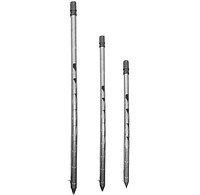
The main constructive elements of the sampler:
• outer pipe (body);
• internal pipe;
• tip in the form of a cone;
• holes for sampling;
• rotating handle with stops;
• hole for pouring grain samples.
The outer pipe forms the body of the sampler and has a conical tip. Its cylindrical wall separates the grain mass from getting inside. On the tubular surface of the casing there are holes-grooves of an elongated shape, when openedwhich grains can penetrate into the internal cavity. The hole location line encircles the outer pipe spirally for approximately half a turn.
The inner pipe forms acapacity forgrain sample. Its walls help to close the openings of the case by overlapping them. There are also holes on the inner tube, the shape of which coincides with the grooves of the body, but with a second slope*.
*The directional opposite arrangement of grooved holes is used for taking samples "diagonally". Such a fence protects samples from damage to grains that could be caused by pinching between the moving parts of the sampler. The difference in inclination between the holes excludes the coincidence of the edges of the grooves of the outer and inner pipes. Their edges move relative to each other in such a way that individual particles of the sample are displaced, avoiding pinching, deformation or cutting.
The smooth conical tip forms a point that facilitates the introduction of the sampler body into the tested grain heap by moving its particles to the sides.
The handle movably connects the outer and inner pipes. This element of the sampler has a stop mechanism with two positions. When the handle is turned around the axis, the inner tube in the body rotates, thereby closing and opening the intake grooves. There is a special hole on the end of the handle for extracting a grain sample from the sampler into a container for storing grain samples.
Руководство по хорошения(//tractor-service.com)
List of actions when taking grain samples with a manual sampler of the RP:
1. Close intake openings, turn the handle in the appropriate direction to the stop around the longitudinal axis of the device.
2. Plunge the device forward with the conical tip to the required depth into the grain mound.
3. Close the intake holes, return the handle to the original position (from the 1st item on the list).
4. Extract the device filled with samples from different levels from the product under investigation.
5. Pour the taken grain sample through the hole on the end of the handle into the sample container (KHOZ), turning the RP sampler upwards with the conical tip.
In order to speed up the process of filling the internal cavity with grain, it is possible to raise and lower the device several times with a small amplitude along the longitudinal axis.
Prices:
RP-1.6x35 - UAH 1236.00. RP-1,6x50-1482.00 UAH.
RP-2.1x35 - UAH 1446.00, RP-2.1x50 - UAH 1680.00;
RP-3.0x35- UAH 2266.00, RP-3.0x50- UAH 2670.00
Warranty - 12 months.
Delivery across Ukraine by Novaya Pochta, Intime, SAT, Delivery delivery services.
Call! We will be glad to help you. О97 ОЗ8 2О 42, О66 ЗЗ2 47 18
Samplers are widely used at grain processing and bread-making enterprises, plants for the production of compound feed products, and other agricultural organizations, including GHI — bodies that control the quality of bread products, grain and flour.
The main constructive elements of the sampler:
• outer pipe (body);
• internal pipe;
• tip in the form of a cone;
• holes for sampling;
• rotating handle with stops;
• hole for pouring grain samples.
The outer pipe forms the body of the sampler and has a conical tip. Its cylindrical wall separates the grain mass from getting inside. On the tubular surface of the casing there are holes-grooves of an elongated shape, when openedwhich grains can penetrate into the internal cavity. The hole location line encircles the outer pipe spirally for approximately half a turn.
The inner pipe forms acapacity forgrain sample. Its walls help to close the openings of the case by overlapping them. There are also holes on the inner tube, the shape of which coincides with the grooves of the body, but with a second slope*.
*The directional opposite arrangement of grooved holes is used for taking samples "diagonally". Such a fence protects samples from damage to grains that could be caused by pinching between the moving parts of the sampler. The difference in inclination between the holes excludes the coincidence of the edges of the grooves of the outer and inner pipes. Their edges move relative to each other in such a way that individual particles of the sample are displaced, avoiding pinching, deformation or cutting.
The smooth conical tip forms a point that facilitates the introduction of the sampler body into the tested grain heap by moving its particles to the sides.
The handle movably connects the outer and inner pipes. This element of the sampler has a stop mechanism with two positions. When the handle is turned around the axis, the inner tube in the body rotates, thereby closing and opening the intake grooves. There is a special hole on the end of the handle for extracting a grain sample from the sampler into a container for storing grain samples.
Руководство по хорошения(//tractor-service.com)
List of actions when taking grain samples with a manual sampler of the RP:
1. Close intake openings, turn the handle in the appropriate direction to the stop around the longitudinal axis of the device.
2. Plunge the device forward with the conical tip to the required depth into the grain mound.
3. Close the intake holes, return the handle to the original position (from the 1st item on the list).
4. Extract the device filled with samples from different levels from the product under investigation.
5. Pour the taken grain sample through the hole on the end of the handle into the sample container (KHOZ), turning the RP sampler upwards with the conical tip.
In order to speed up the process of filling the internal cavity with grain, it is possible to raise and lower the device several times with a small amplitude along the longitudinal axis.
Prices:
RP-1.6x35 - UAH 1236.00. RP-1,6x50-1482.00 UAH.
RP-2.1x35 - UAH 1446.00, RP-2.1x50 - UAH 1680.00;
RP-3.0x35- UAH 2266.00, RP-3.0x50- UAH 2670.00
Warranty - 12 months.
Delivery across Ukraine by Novaya Pochta, Intime, SAT, Delivery delivery services.
Call! We will be glad to help you. О97 ОЗ8 2О 42, О66 ЗЗ2 47 18
|
Shop, contacts | |
Oleg / reviews, info. / evaluation activities | |
|
Phone:
+38 xxxxxx
show
| |
All user ads ~50 | |
Ad ID: #959899
(added by a registered user, registration date: 17-09-2019)
Added/Updated: 09-14-2026 10:20 (current, until: 09-14-2027)
Permanent Ad Address:
Impressions / views for today: ?, total: ?
Similar ads
Among them there are many interesting ones...







Total17 similar adsin the heading "Grain samplers"
All Ukraine: Agricultural machinery, equipment, inventory 45642 / Post-harvest processing, storage (equipment) 1197 / Samplers grains 17
Poltava region:Agricultural machinery, equipment, inventory 2423 / Post-harvest processing, storage (equipment) 142 / Grain samplers 1