/ Fertilizers and plant protection products / Herbicides / Herbicide Primus (Prima, Elegant) 2, 4-D, 452, 42 g/...
For sale / buy
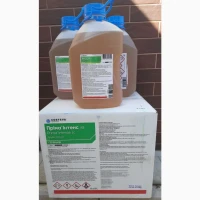
Herbicide Primus (Prima, Elegant) 2, 4-D, 452, 42 g/l + florasulam 6, 3 g/l, for wheat, Kyiv
Region:all Ukraine,
Kyiv
(Belaya tserkov)
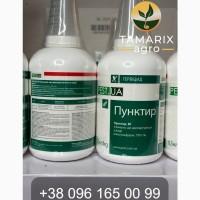
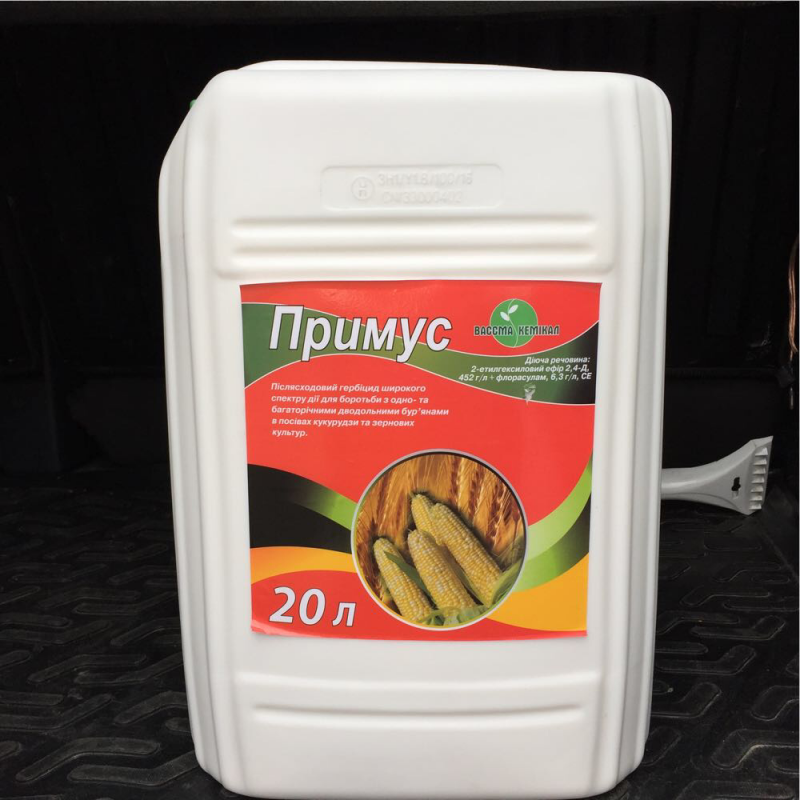
Herbicide Primus analogue of Prima, Elegant; 2,4-D, 452.42 g/l + florasulam 6.3 g/l, for wheat, barley, corn
Content of the active substance
2-ethylhexyl ether, 2.4 D - 452 g/l + florasulam, 6.3 g/l CE
Chemical group
Florasulam belongs to the class of triazolopyrimidines, 2-ethylethylhexyl ether 2,4-D - to the derivatives of aryloxyalkanecarboxylic acids.
Preparative form
Suspension emulsion
Packaging
20 l
Destroys a wide range of dicotyledonous weeds, including such malicious species as sedum sedum, sweet chamomile, field thistle, yellow thistle, and others.
It has a wide range of terms of use ongrain ears: starting from the phase of the 3rd leaf to the formation of the 2nd internode.
Selective in relation to all types of cereals.
The presence of two diverse mechanisms of action reduces the risk of resistance in weeds sensitive to the drug.
Precipitation an hour after processing does not affect the effectiveness of the drug.
Due to the short half-life (14-20 days) of the active substances, it quickly degrades in the soil, without creating problems for subsequent crop rotations.
MECHANISM OF ACTION
Due to its excellent systemic activity, PRIMUS easily penetrates the tissues of weeds and quickly (within an hour) spreads throughout the plant, blocking growth processes. Visual symptoms of lesions in sensitive weeds appear 1-3 days after treatment, and their death occurs on the 7-14th day.
Cost norms and terms of application:
Culture
Harmful object
Consumption rates of the drug, l/ha
Application method
Wheat, barley
Annual and perennial dicot weeds(//tractor-service.com)
0.4-0.6
Spraying from the tillering phase to the formation of 1-2 internodes of the culture
Corn
Spraying from phase 3 to phase 7 (inclusive) of leaves in crops
Properties of the drug
The powerful herbicidal effect of PRIMUS is provided due to the combined synergistic activity of the two active substances. In cereal crops, it destroys more than 150 dicotyledonous weeds (including species resistant to 2,4-D and 2M-4X), including: bitter gorse, species of chamomile, field thistle, yellow thistle, field birch, blue cornflower, field mustard, shepherd's purse, field talaban, wild radish, white quinoa, poppy self-seeding, species of styrica, medium star, mountain species, birch buckwheat, ragweed, Sophia deskurenia, Tatar lettuce, dandelion, etc.
Recommendations for use
Application features
It can be used at a temperature from + 5 to + 25 But the most optimal temperature is more than + 8.
When there is an active growth of weeds and the drug works faster. It is forbidden to process crops when there is a threat of night frosts. In the case of late processing, with overgrown weeds, the maximum consumption rate is selected.
Rate of consumption of working solution
300-400 l/ha
Compatibility
In tank mixtures, it is combined with insecticides, fungicides, growth regulators and nitrogen fertilizers. Before use, it is necessary to check the mixture for the compatibility of the components.
Limitations in application
Do not use herbicide on cereals with beans; in the case of reseeding, use only cereals; do not allow the transfer of the drug to fields occupied by broad-leaved crops.
WHO classification, toxicological characteristics
Class III (moderately dangerous)
Storage of the drug
Storage conditions
The drug should be stored in a closed factory container with a label in a dry, ventilated room designed for storing pesticides at temperatures from -5 to +20°C. Store separately from food products, seeds, fodder, in places inaccessible to children.
Storage period
2 years from the date of manufacture of the drug.
Content of the active substance
2-ethylhexyl ether, 2.4 D - 452 g/l + florasulam, 6.3 g/l CE
Chemical group
Florasulam belongs to the class of triazolopyrimidines, 2-ethylethylhexyl ether 2,4-D - to the derivatives of aryloxyalkanecarboxylic acids.
Preparative form
Suspension emulsion
Packaging
20 l
Destroys a wide range of dicotyledonous weeds, including such malicious species as sedum sedum, sweet chamomile, field thistle, yellow thistle, and others.
It has a wide range of terms of use ongrain ears: starting from the phase of the 3rd leaf to the formation of the 2nd internode.
Selective in relation to all types of cereals.
The presence of two diverse mechanisms of action reduces the risk of resistance in weeds sensitive to the drug.
Precipitation an hour after processing does not affect the effectiveness of the drug.
Due to the short half-life (14-20 days) of the active substances, it quickly degrades in the soil, without creating problems for subsequent crop rotations.
MECHANISM OF ACTION
Due to its excellent systemic activity, PRIMUS easily penetrates the tissues of weeds and quickly (within an hour) spreads throughout the plant, blocking growth processes. Visual symptoms of lesions in sensitive weeds appear 1-3 days after treatment, and their death occurs on the 7-14th day.
Cost norms and terms of application:
Culture
Harmful object
Consumption rates of the drug, l/ha
Application method
Wheat, barley
Annual and perennial dicot weeds(//tractor-service.com)
0.4-0.6
Spraying from the tillering phase to the formation of 1-2 internodes of the culture
Corn
Spraying from phase 3 to phase 7 (inclusive) of leaves in crops
Properties of the drug
The powerful herbicidal effect of PRIMUS is provided due to the combined synergistic activity of the two active substances. In cereal crops, it destroys more than 150 dicotyledonous weeds (including species resistant to 2,4-D and 2M-4X), including: bitter gorse, species of chamomile, field thistle, yellow thistle, field birch, blue cornflower, field mustard, shepherd's purse, field talaban, wild radish, white quinoa, poppy self-seeding, species of styrica, medium star, mountain species, birch buckwheat, ragweed, Sophia deskurenia, Tatar lettuce, dandelion, etc.
Recommendations for use
Application features
It can be used at a temperature from + 5 to + 25 But the most optimal temperature is more than + 8.
When there is an active growth of weeds and the drug works faster. It is forbidden to process crops when there is a threat of night frosts. In the case of late processing, with overgrown weeds, the maximum consumption rate is selected.
Rate of consumption of working solution
300-400 l/ha
Compatibility
In tank mixtures, it is combined with insecticides, fungicides, growth regulators and nitrogen fertilizers. Before use, it is necessary to check the mixture for the compatibility of the components.
Limitations in application
Do not use herbicide on cereals with beans; in the case of reseeding, use only cereals; do not allow the transfer of the drug to fields occupied by broad-leaved crops.
WHO classification, toxicological characteristics
Class III (moderately dangerous)
Storage of the drug
Storage conditions
The drug should be stored in a closed factory container with a label in a dry, ventilated room designed for storing pesticides at temperatures from -5 to +20°C. Store separately from food products, seeds, fodder, in places inaccessible to children.
Storage period
2 years from the date of manufacture of the drug.
Advertisement ID: #902674
(added by registered users) by the user)
Permanent ad address:
Showed / watched for today: ?, total: ?
Similar fresh ads
Among them there are many interesting...