/ Fertilizers and plant protection products / Herbicides / Griznyi Expert - Systemic herbicide against...
Sell / buy
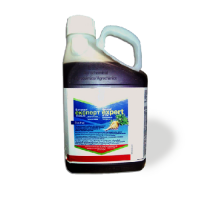
Grizny Expert - Systemic herbicide against dicot weeds in crops sunflower, Kyiv region.
Price15$
Region:all Ukraine,
Kyiv region.
(Vyshhorodok)
Updated:
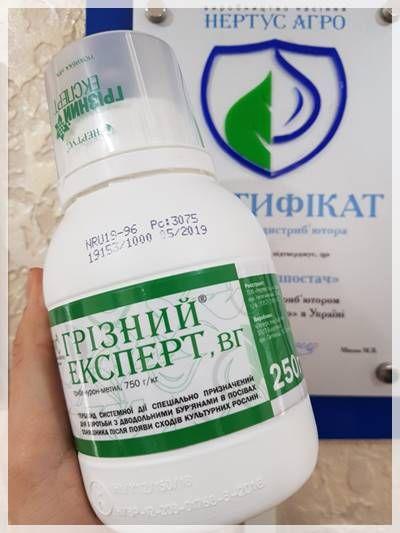
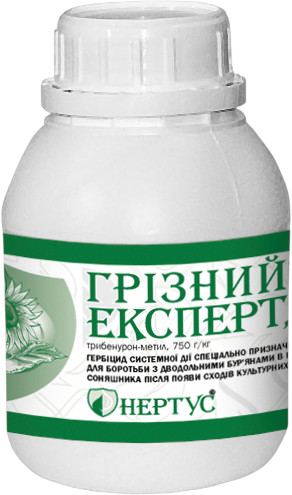
Grizny Expert® - Systemic herbicide, specially designed to combat annual and perennial dicotyledonous weeds in sunflower crops resistant to sulfonylurea herbicides
Active substance: tribenuron-methyl, 750 g/kg
Formulation: water-soluble granules
Manufacturer: Peters & Burg KFT, Hungary
Packaging unit: 250 g bottle
Characteristics and advantages:
The possibility of combating annual and perennial dicotyledonous weeds in the period after the emergence of sunflower seedlings.
The only tool for destroying thistles in sunflower crops.
A wide window of application — in the period from 2 to 6 leaves in cultivated plants.
Flexible norms and schemes of drug application in accordance with the type of weediness of the field, as well as the number of weeds.
Mechanism of action:
The Horrible Expert® herbicide is used only on sunflower crops that are resistant to this herbicide. The active substance penetrates the plant through its aerial part, moves to the apical meristem zones of the plant, where it blocks cell division processes in plants of sensitive weeds. As a result, weed growth stops a few hours after applying the drug, and weed plants eventually die.
Recommendations for use:
When fighting weeds, the surface of which is poorly wetted (ambrosia, quinoa species, thistle species, etc.), as well as under arid conditions, to enhance the effect of the Horrible Expert® herbicide, it should be used with Talant® surfactant at the rate of 0.1 l per 100 l of working solution.
Compatibility with other drugs:
The Horrible Expert® herbicide is compatible with the vast majority of pesticides and agrochemicals, however, in each individual case, a preliminary check of the compatibility of the components of the tank mixture should be carried out. Do not use the Horrible Expert® herbicide in a mixture with graminicides. In cases where it is necessary to apply anti-grass herbicides, they should be applied 7 days before the treatment of sowing with the herbicide Gryznyi Expert® or 7 days after its application.
Regulations for the use of the drug:
Culture - The object against which it is treated - The rate of consumption of the drug, g/ha - The maximum frequency of treatments
Sunflower (//tractor-service.com)
Annual and perennial dicotyledonous weeds
15 - 25* + South Africa Talent
(0.1% of the volume of the working solution)
2
25 - 50*
1
* - The consumption rate of the drug depends on the type of resistance of a specific sunflower hybrid to this herbicide.
Administration of the drug:
Horrible Expert® herbicide is used only on sunflower hybrids that are resistant to sulfonylureas. The drug is applied using groundsprayers at a wind speed of up to 5 m/s. When applying the drug, it is necessary to avoid spilling the working solution on crops of sensitive crops.
Rate of consumption of the working solution: 185
Становить 200 - 300 л/га. При густому стоянні рослин норма витрати робочого розчину має бути не менше 300 л/га для забезпечення повного і рівномірного змочування всієї поверхні бур'янів робочим розчином. Норма витрати робочого розчину не повинна спричиняти його стікання з поверхні рослин під час внесення. Робочий розчин препарату має бути використаний впродовж робочого дня.
Range of action:
HRIZNY EXPERT® effectively destroys annual and perennial dicotyledonous weeds, including species of thistles, thistles, species of chamomile,mustard field mustard, wild radish, types of poppies, descourainia Sophia, field violet and other weeds.
The effectiveness of the GRIZNY EXPERT® herbicide will be observed when the weed plants are in the following phases at the time of spraying:
ragweed - cotyledons - up to 2 true leaves at most;
white quinoa - cotyledons - up to 4 real leaves;
podmarennik tenacious - up to phase 3-4 rings;
other annual dicotyledons - up to 4–6 real leaves;
perennial dicotyledons - the rosette phase - the beginning of stem growth.
Signs of herbicidal action:
The first visual signs of the drug's effect on weeds appear 7-10 days after treatment. Complete death of weeds occurs after 15 - 20 days. Adverse weather conditions for plant development (low temperatures, drought) slow down the effect of the drug and the manifestation of visual signs of herbicidal action.
Active substance: tribenuron-methyl, 750 g/kg
Formulation: water-soluble granules
Manufacturer: Peters & Burg KFT, Hungary
Packaging unit: 250 g bottle
Characteristics and advantages:
The possibility of combating annual and perennial dicotyledonous weeds in the period after the emergence of sunflower seedlings.
The only tool for destroying thistles in sunflower crops.
A wide window of application — in the period from 2 to 6 leaves in cultivated plants.
Flexible norms and schemes of drug application in accordance with the type of weediness of the field, as well as the number of weeds.
Mechanism of action:
The Horrible Expert® herbicide is used only on sunflower crops that are resistant to this herbicide. The active substance penetrates the plant through its aerial part, moves to the apical meristem zones of the plant, where it blocks cell division processes in plants of sensitive weeds. As a result, weed growth stops a few hours after applying the drug, and weed plants eventually die.
Recommendations for use:
When fighting weeds, the surface of which is poorly wetted (ambrosia, quinoa species, thistle species, etc.), as well as under arid conditions, to enhance the effect of the Horrible Expert® herbicide, it should be used with Talant® surfactant at the rate of 0.1 l per 100 l of working solution.
Compatibility with other drugs:
The Horrible Expert® herbicide is compatible with the vast majority of pesticides and agrochemicals, however, in each individual case, a preliminary check of the compatibility of the components of the tank mixture should be carried out. Do not use the Horrible Expert® herbicide in a mixture with graminicides. In cases where it is necessary to apply anti-grass herbicides, they should be applied 7 days before the treatment of sowing with the herbicide Gryznyi Expert® or 7 days after its application.
Regulations for the use of the drug:
Culture - The object against which it is treated - The rate of consumption of the drug, g/ha - The maximum frequency of treatments
Sunflower (//tractor-service.com)
Annual and perennial dicotyledonous weeds
15 - 25* + South Africa Talent
(0.1% of the volume of the working solution)
2
25 - 50*
1
* - The consumption rate of the drug depends on the type of resistance of a specific sunflower hybrid to this herbicide.
Administration of the drug:
Horrible Expert® herbicide is used only on sunflower hybrids that are resistant to sulfonylureas. The drug is applied using groundsprayers at a wind speed of up to 5 m/s. When applying the drug, it is necessary to avoid spilling the working solution on crops of sensitive crops.
Rate of consumption of the working solution: 185
Становить 200 - 300 л/га. При густому стоянні рослин норма витрати робочого розчину має бути не менше 300 л/га для забезпечення повного і рівномірного змочування всієї поверхні бур'янів робочим розчином. Норма витрати робочого розчину не повинна спричиняти його стікання з поверхні рослин під час внесення. Робочий розчин препарату має бути використаний впродовж робочого дня.
Range of action:
HRIZNY EXPERT® effectively destroys annual and perennial dicotyledonous weeds, including species of thistles, thistles, species of chamomile,mustard field mustard, wild radish, types of poppies, descourainia Sophia, field violet and other weeds.
The effectiveness of the GRIZNY EXPERT® herbicide will be observed when the weed plants are in the following phases at the time of spraying:
ragweed - cotyledons - up to 2 true leaves at most;
white quinoa - cotyledons - up to 4 real leaves;
podmarennik tenacious - up to phase 3-4 rings;
other annual dicotyledons - up to 4–6 real leaves;
perennial dicotyledons - the rosette phase - the beginning of stem growth.
Signs of herbicidal action:
The first visual signs of the drug's effect on weeds appear 7-10 days after treatment. Complete death of weeds occurs after 15 - 20 days. Adverse weather conditions for plant development (low temperatures, drought) slow down the effect of the drug and the manifestation of visual signs of herbicidal action.
|
Store, contacts | |
Yuriy / feedback, info. / evaluation activities | |
|
Phone:
+38(xxxxxx
show
| |
All ads user ~1000 | |
Ad ID: #1083676
(added by registered user, registration date: 2016-08-10)
Added / Updated: 2026-09-23 09:26 (current, until: 09-23-2027)
Permanent Ad Address:
Impressions / views for today: ?, total: ?