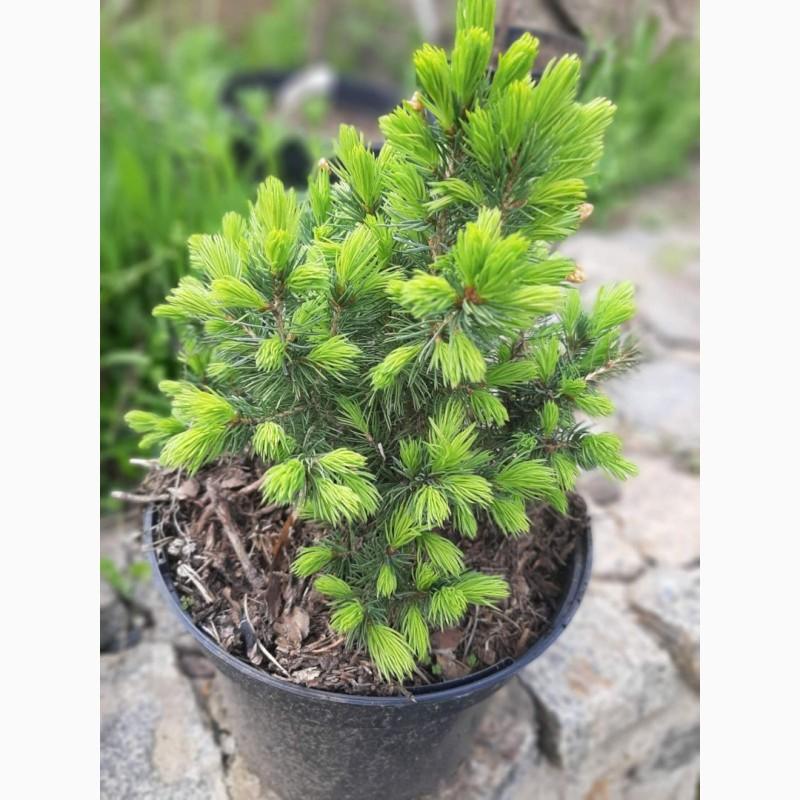
/ Seeds, seedlings and sowing materials / Various seeds, seedlings and sowing materials + in assortment / Konika Canadian spruce C2 3 years old

For sale / buy
Konika Canadian elm C2 3 years old, Dnipropetrovsk region.
Price250 UAH.
Region:
Dnepropetrovsk region.
(Dnipropetrovsk region. city of Dnipro w/m Topolya-2)
Updated:
Coniferous plants are very popular among gardeners. In nature, there are many different types of coniferous plants, but almost all of them are large trees. Because of this, not all species can be grown in amateur gardens. Of course, it is possible to limit the growth of large conifers and form a compact crown artificially, but dwarf forms of conifers will look much better and more natural on a small plot.
It is necessary to choose a place for planting that is slightly shaded, protected from the wind. In spring, it should not be flooded by floods, this can lead to the death of the spruce. Planting can be carried out at any time of the year, in warm regions - even in winter, when the plant is in a state of complete rest. The best time for planting is spring and autumn. If the transplant is carried out in the summer, it is important to choose a cloudy, cool day. The next week they shade it from sunlight and water it twice a week at 8-10 liters per plant.
For full-fledged growth, the soil should be light and rich in organic matter. For Canadian "Conica" oils, loams are suitable, as well as any soils with a deep humus layer; too dry, dense, low-fertility, calcareous soils are undesirable. A bucket of rotted manure and 60-80 g ofcomplex fertilizer long-acting for conifers are placed in the planting hole. If the soil is sandy or clayey, add earth and compost. After planting, the soil must be mulched with peat in a layer of 5-7 cm.
(//tractor-service.com)
Conica spruce care
Care for this Christmas tree is minimal, it practically does not require attention. But still there are subtleties in care. El Konyka gratefully responds to the spraying of needles and the application of fertilizer. Its root system is superficial with a weak tap root. Shallow loosening of the soil and mulching will ensure access to oxygen and constant moderate humidity. In the absence of rain, frequent watering of Canadian Christmas trees is necessary.
Need shelter for the winter. This is done not only to protect against frost, since the horsetail is a frost-resistant tree, it will protect against sunburn, which it can get starting from February. It is at the end of winter - beginning of spring that solar activity increases, but the root system of the tree is still "not working".
The crown is covered with burlap, cardboard or other improvised materials. The lower part of the plant remains open to avoid constipation. If the Christmas tree was still damaged by the sun's rays, it can be restored without cutting bare branches. Starting from April, the damaged tree is sprayed with a hose every day. Such a "shower" leads to the growth of fresh needles on seemingly dead branches.
It is necessary to choose a place for planting that is slightly shaded, protected from the wind. In spring, it should not be flooded by floods, this can lead to the death of the spruce. Planting can be carried out at any time of the year, in warm regions - even in winter, when the plant is in a state of complete rest. The best time for planting is spring and autumn. If the transplant is carried out in the summer, it is important to choose a cloudy, cool day. The next week they shade it from sunlight and water it twice a week at 8-10 liters per plant.
For full-fledged growth, the soil should be light and rich in organic matter. For Canadian "Conica" oils, loams are suitable, as well as any soils with a deep humus layer; too dry, dense, low-fertility, calcareous soils are undesirable. A bucket of rotted manure and 60-80 g ofcomplex fertilizer long-acting for conifers are placed in the planting hole. If the soil is sandy or clayey, add earth and compost. After planting, the soil must be mulched with peat in a layer of 5-7 cm.
(//tractor-service.com)
Conica spruce care
Care for this Christmas tree is minimal, it practically does not require attention. But still there are subtleties in care. El Konyka gratefully responds to the spraying of needles and the application of fertilizer. Its root system is superficial with a weak tap root. Shallow loosening of the soil and mulching will ensure access to oxygen and constant moderate humidity. In the absence of rain, frequent watering of Canadian Christmas trees is necessary.
Need shelter for the winter. This is done not only to protect against frost, since the horsetail is a frost-resistant tree, it will protect against sunburn, which it can get starting from February. It is at the end of winter - beginning of spring that solar activity increases, but the root system of the tree is still "not working".
The crown is covered with burlap, cardboard or other improvised materials. The lower part of the plant remains open to avoid constipation. If the Christmas tree was still damaged by the sun's rays, it can be restored without cutting bare branches. Starting from April, the damaged tree is sprayed with a hose every day. Such a "shower" leads to the growth of fresh needles on seemingly dead branches.
|
Shop, contacts | |
Svetlana Nikolaevna / отзывы, INFO. / Оценка ACTIVITY | |
|
Telephone:
0962xxxxxx
show
| |
All user ads ~32 | |
Ad ID: #1191042
(added by a registered user, registration date: 07-03-2019)
Added/Updated: 10-20-2025 13:10 (relevant, until: 10-20-2026)
Permanent ad address:
Showed / watched for today: ?, total: ?
Similar ads
Among them there are many interesting...



All Ukraine: Seeds, seedlings and seeds materials 1204 / Various seeds, seedlings and sowing materials + in assortment 244
Dnepropetrovsk region: Seeds, seedlings and sowing materials materials 123 / Various seeds, seedlings and seed materials + in assortment 27