/ Fertilizers and plant protection products / Herbicides / Milafort KS - systemic herbicide for combating...
Sell / buy
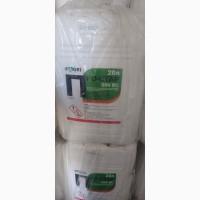
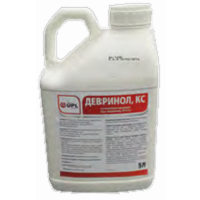
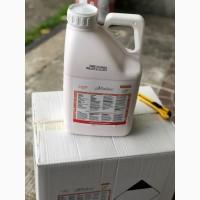
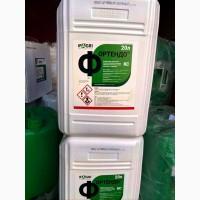
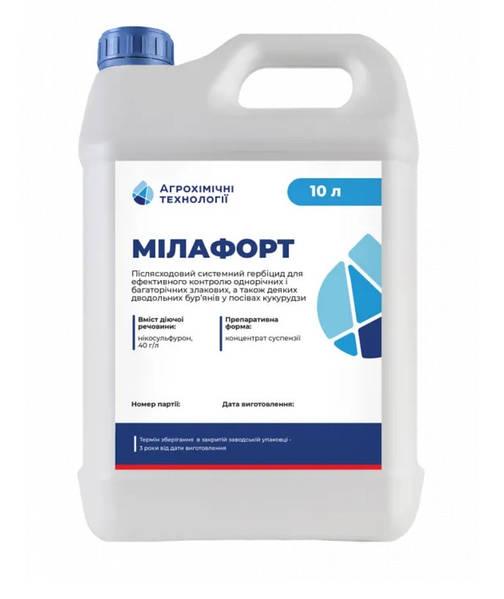
Milafort KS - a systemic herbicide for the control of weeds in corn crops, Kyiv region.
Price7.5$
Region:all Ukraine,
Kyiv region region.
(Vyshhorodok)
Updated:
Herbicide Milafort KS is a systemic post-emergence herbicide for combating annual, perennial and some dicotyledonous weeds in corn crops.
Active substance: nicosulfuron, 40 g/l.
Action: Systemic post-emergence herbicide.
Target: Annual, perennial grasses and some dicotyledonous weeds.
Crops:Corn. Preparative form: Suspension concentrate.
Container: 10 l canister, the price is for 1 l.
Advantages of the drug Milafort:
Selective to culture; Penetrates into plants both through leaves and stems; It is used in a wide range of phases of corn development - from 3 to 10 leaves; The preparation form contains emulsifiers of vegetable origin and does not require additional surfactants and active additives;
A good tank partner for herbicides against dicotyledonous weeds;
Has no effect on subsequent crops.
Minimal phytotoxicity; Enhanced herbicidal effect.
WARNING! Be sure to shake the contents of the can thoroughly before applying!
Application of Milafort Herbicide:
Culture Target object Phase of drug application Rates of drug consumption, kg/ha Rate of working solution consumption, l/ha
(//tractor-service.com)
Corn
Annual cereals and some dicotyledonous weeds
3-10 leaves of corn
1.0
300
Corn
Perennial grasses and some dicotyledonous weeds
3-10 leaves of corn
1.25
300
Main types of weeds controlled by Milafort:
creeping wheatgrass common common flat grass common flat grass Weeds sensitivity to Milafort Susceptible: creeping wheatgrass Chicken millet Common ryegrass Foxtail Common ragweed Ryegrass (to be bushed) Common common sedge Green mouse Green mouse Wild milletField mustard Wild radish Buckwheat common schirytsia Common sedum of the field Medium-sensitive: Veronica (species) Common yellowwort Common starwort Common stokolos (species) Tartar buckwheat Millet hairy** Common sedum White loboda (up to 2 leaves)** Long-legged annual Resistant: Ambrosia spp. Birch Sporish common *The sensitivity of weeds indicated in the catalog may change depending on weather conditions, as well as under the influence of the emergence of resistance of certain types of weeds to active substances. ** at the rate of application of Milafort - 1.25 l/ha.
Recommendations for use Herbicide treatment must be carried out during the period of intensive growth of weeds and in the phase of corn development of 3-10 leaves. Ideal conditions for processing are temperatures from +15 °C to +23 °C.
It is not recommended to use the drug in cold or hot weather, when the plants are in a state of stress. For the maximum effectiveness of the drug, the relative humidity of the air should be at least 40-50%. Does not require the use of additional adjuvants andadhesives.
Mechanism of action:
Nicosulfuron, being absorbed by the leaves and stems of weeds, quickly moves to their root system, blocks the synthesis of the main amino acids (valine and isoleucine), stopping the growth and division of cells, after which the growth of weeds stops, they acquire a reddish hue and gradually die.
Speed of action Visible symptoms of the lesion (reddish tint) appear after about 7-10 days, gradually dying off. Recommended tank mixtures Milafort + Disulam The use of this tank mixture allows you to destroy the vast majority of annual and perennial grass and dicot weeds in corn crops in one application. There is an increase in biological effectiveness against dicotyledonous weeds (white quinoa, Persian veronica, medium star, black solanum, field birch, etc.) Influence of water pH on the effectiveness of Milafort Acidic (5.5-6.5) Neutral (6.5-7.5) Alkaline (7.5-8.0) good good acceptable* *in case of an alkaline reaction of water or working solution, use a working solution solution as soon as possible to avoid alkaline hydrolysis of nicosulfuron.
Active substance: nicosulfuron, 40 g/l.
Action: Systemic post-emergence herbicide.
Target: Annual, perennial grasses and some dicotyledonous weeds.
Crops:Corn. Preparative form: Suspension concentrate.
Container: 10 l canister, the price is for 1 l.
Advantages of the drug Milafort:
Selective to culture; Penetrates into plants both through leaves and stems; It is used in a wide range of phases of corn development - from 3 to 10 leaves; The preparation form contains emulsifiers of vegetable origin and does not require additional surfactants and active additives;
A good tank partner for herbicides against dicotyledonous weeds;
Has no effect on subsequent crops.
Minimal phytotoxicity; Enhanced herbicidal effect.
WARNING! Be sure to shake the contents of the can thoroughly before applying!
Application of Milafort Herbicide:
Culture Target object Phase of drug application Rates of drug consumption, kg/ha Rate of working solution consumption, l/ha
(//tractor-service.com)
Corn
Annual cereals and some dicotyledonous weeds
3-10 leaves of corn
1.0
300
Corn
Perennial grasses and some dicotyledonous weeds
3-10 leaves of corn
1.25
300
Main types of weeds controlled by Milafort:
creeping wheatgrass common common flat grass common flat grass Weeds sensitivity to Milafort Susceptible: creeping wheatgrass Chicken millet Common ryegrass Foxtail Common ragweed Ryegrass (to be bushed) Common common sedge Green mouse Green mouse Wild milletField mustard Wild radish Buckwheat common schirytsia Common sedum of the field Medium-sensitive: Veronica (species) Common yellowwort Common starwort Common stokolos (species) Tartar buckwheat Millet hairy** Common sedum White loboda (up to 2 leaves)** Long-legged annual Resistant: Ambrosia spp. Birch Sporish common *The sensitivity of weeds indicated in the catalog may change depending on weather conditions, as well as under the influence of the emergence of resistance of certain types of weeds to active substances. ** at the rate of application of Milafort - 1.25 l/ha.
Recommendations for use Herbicide treatment must be carried out during the period of intensive growth of weeds and in the phase of corn development of 3-10 leaves. Ideal conditions for processing are temperatures from +15 °C to +23 °C.
It is not recommended to use the drug in cold or hot weather, when the plants are in a state of stress. For the maximum effectiveness of the drug, the relative humidity of the air should be at least 40-50%. Does not require the use of additional adjuvants andadhesives.
Mechanism of action:
Nicosulfuron, being absorbed by the leaves and stems of weeds, quickly moves to their root system, blocks the synthesis of the main amino acids (valine and isoleucine), stopping the growth and division of cells, after which the growth of weeds stops, they acquire a reddish hue and gradually die.
Speed of action Visible symptoms of the lesion (reddish tint) appear after about 7-10 days, gradually dying off. Recommended tank mixtures Milafort + Disulam The use of this tank mixture allows you to destroy the vast majority of annual and perennial grass and dicot weeds in corn crops in one application. There is an increase in biological effectiveness against dicotyledonous weeds (white quinoa, Persian veronica, medium star, black solanum, field birch, etc.) Influence of water pH on the effectiveness of Milafort Acidic (5.5-6.5) Neutral (6.5-7.5) Alkaline (7.5-8.0) good good acceptable* *in case of an alkaline reaction of water or working solution, use a working solution solution as soon as possible to avoid alkaline hydrolysis of nicosulfuron.
|
Shop, contacts | |
Yuriy / feedback, info. / evaluation activities | |
|
Phone:
+38(xxxxxx
show
| |
All ads user ~1000 | |
Ad ID: #893311
(added by registered user, registration date: 2016-08-10)
Added / Updated: 10-15-2025 09:16 (current, until: 10-15-2026)
Permanent Ad Address:
Impressions / views for today: ?, total: ?
Similar ads
There are many interesting ones among them...