/ Bees, honey and beekeeping products, equipment / Equipment for apiaries / Beehives / Vulik "Kozatskyi", representative...


For sale / buy
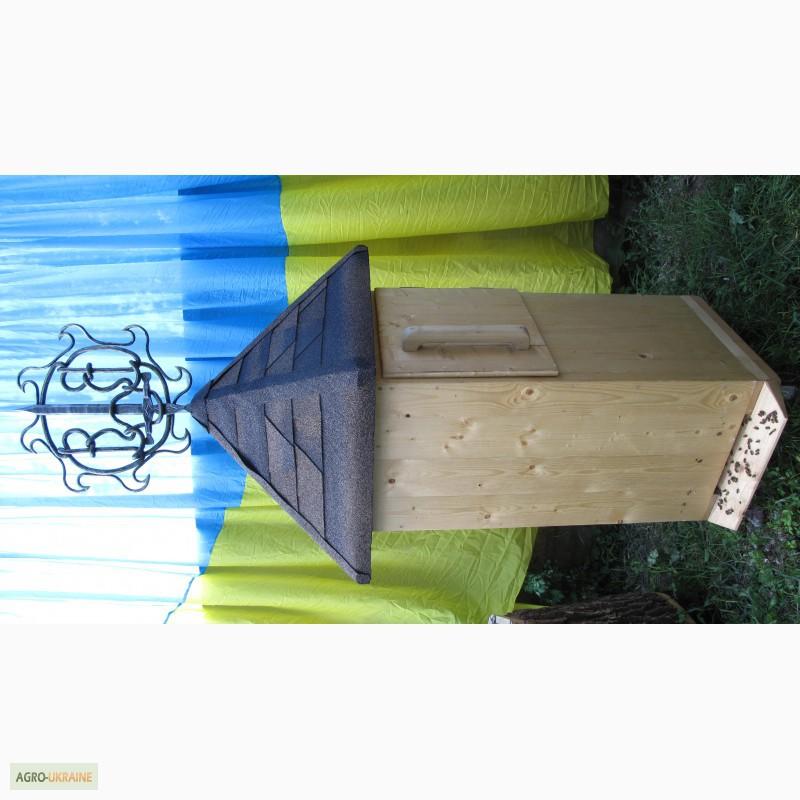
Vulik "Kozatskyi", representative model, for sale, Lviv region.
Region:
Lviv region.
(Chervonograd)
Vulik "Kozatskyi" has an internal nest and external housings. The air space formed between these bodies performs the role of not only an air cushion. Along the perimeter of the inner side of the outer honey body, slats are attached, on top of which the collateral shield fits as tightly as possible. As a result of the formation of such tightness, the ventilation in the hive acquires a toroidal, cyclic form. Thanks to this, the beehive's nest is protected from the heat in the summer, and from the cold in the winter. Due to the decrease in the temperature difference between the air used by the bees and the external environment, the release of condensate in winter is minimal.
The design of the beehive differs in that the access of gathering bees to the upper honey frames occurs through the air space formed between the outer and inner housings. The bees themselves choose a more convenient and faster way to the honey frames, bypassing the inner housing with the nest frames, thanks to which the created microclimate of the nest part is not disturbed, and the honey part receives increased ventilation for faster nectar concentration. It should be noted that overloading the nest part of the hive with the flow of forager bees increases the probability of bee swarming. The presence of a single fly in this hive, as a rule and in natural conditions, makes it impossible for drafts to form in the bee nest.
In order for the bee colony to develop intensively and provide it with a suitable microclimate in its nest, it is necessary to create the conditions closest to natural ones. Therefore, the design of the beehive should have the shape of a natural tree hollow, which is the best dwelling, of all known to us, i.e. vertically elongated with a cross section close to the diameter of a natural bee hive, which, according to many observations, is no more than 8 combs on average. The volume of the nest part is also determined taking into account the maximum egg-laying intensity of the uterus per day and the time until hatchingof a worker bee from a cell. That is, in this hive we get a concentrated bee nest. For manufacturability and versatility, the square shape of the housings with the following frame sizes has been implemented - 8 frames measuring 300x435 mm are installed on the inner nest housing, 12 frames measuring 435x145 mm on the external honey housings. or 435x300 mm. 8 frames measuring 300x145 mm are used for internal honey boxes. The height of honey frames can be further increased. In this design of the beehive, the bees fill the honey frames with nectar starting exactly from the nest part, i.e. from the bottom to the top.
The design of the beehive differs in that the access of gathering bees to the upper honey frames occurs through the air space formed between the outer and inner housings. The bees themselves choose a more convenient and faster way to the honey frames, bypassing the inner housing with the nest frames, thanks to which the created microclimate of the nest part is not disturbed, and the honey part receives increased ventilation for faster nectar concentration. It should be noted that overloading the nest part of the hive with the flow of forager bees increases the probability of bee swarming. The presence of a single fly in this hive, as a rule and in natural conditions, makes it impossible for drafts to form in the bee nest.
In order for the bee colony to develop intensively and provide it with a suitable microclimate in its nest, it is necessary to create the conditions closest to natural ones. Therefore, the design of the beehive should have the shape of a natural tree hollow, which is the best dwelling, of all known to us, i.e. vertically elongated with a cross section close to the diameter of a natural bee hive, which, according to many observations, is no more than 8 combs on average. The volume of the nest part is also determined taking into account the maximum egg-laying intensity of the uterus per day and the time until hatchingof a worker bee from a cell. That is, in this hive we get a concentrated bee nest. For manufacturability and versatility, the square shape of the housings with the following frame sizes has been implemented - 8 frames measuring 300x435 mm are installed on the inner nest housing, 12 frames measuring 435x145 mm on the external honey housings. or 435x300 mm. 8 frames measuring 300x145 mm are used for internal honey boxes. The height of honey frames can be further increased. In this design of the beehive, the bees fill the honey frames with nectar starting exactly from the nest part, i.e. from the bottom to the top.
Ad ID: #419142
(added by unregistered by the user)
Permanent Ad Address:
Impressions / views for today: ?, total: ?
Similar recent ads
There are many interesting ones among them...
Total58 similar fresh adsin the heading "Beehives"
All Ukraine: Bees, honey and beekeeping products, equipment 858 / Equipment for apiary 133 / Beehives 58