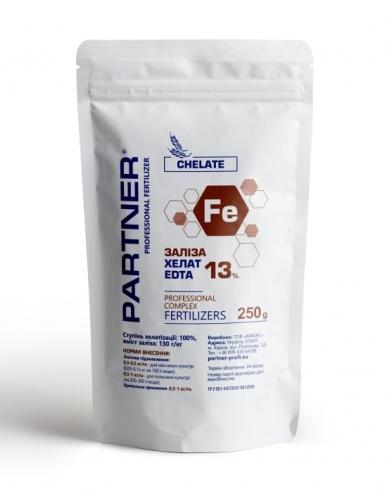
/ Fertilizers and plant protection products / Nitrogen fertilizers / Iron Chelate Fe EDTA 13% Fertilizer PARTNER. 250g


Sell / buy
Iron Chelate Fe EDTA 13% Fertilizer PARTNER. 250g, Kyiv region.
Region:all Ukraine,
Kyiv region.
(Ukraine)
Updated:
Degree of chelation 100%, iron content Fe - 130 g/kg
Iron is a trace element that is absorbed by plants in the largest amount and is a functional component.
Iron is part of the enzymes involved in the formation of chlorophyll, so its deficiency reduces the intensity of photosynthesis in plants, causing chlorosis.
Symptoms of iron deficiency begin with yellowing of leaf veins. These symptoms are similar to magnesium deficiency, as both elements play an important role in the production of chlorophyll. But unlike magnesium, symptoms of iron deficiency begin in young leaves.
The most pronounced sign of chlorosis is light yellow, almost white leaves on young shoots. At the same time, old leaves remain green for a long time, while young ones turn yellow or turn white, and then die. Inflorescences develop weak, small. In addition, with a lack of iron in plants, the synthesis of growth substances - auxins is delayed.
Sensitive to iron deficiency: soybeans and cereals (especiallycorn), fruit crops (apples, peaches, cherries, plums, pears, peaches, apple trees), berry crops (strawberries, raspberries,grapes), vegetable crops (tomatoes, cucumbers, carrots, potatoes, cabbage).
Properties of iron chelate Fe EDTA 13%:
- not toxic;
- does not contain chlorine;(//tractor-service.com)
- stable in the range of the working solution up to pH 6.5;
- compatible with mineral fertilizers;
- completely soluble in water and easily absorbed by plants;
- resistant to the influence of microorganisms;
- slightly binds to sparingly soluble soil compounds;
- differs in high transport activity and permeability through plant leaves;
- compatible with ZZR.
Contribution rates: 163
Позакореневе живлення: 0,3-0,5 кг/га для овочевих; 0,5-1кг/га для зернових.
Drip irrigation: 0.5-1 kg/ha.
Line of trace elements "Chelate"
Trace elements Fe, Cu, Mn, Zn are in chelated form (EDTA) and are absorbed by the plant by 90-95%. Microfertilizers improve the protective properties of crops, their resistance to climatic features and disease attacks.
Iron is a trace element that is absorbed by plants in the largest amount and is a functional component.
Iron is part of the enzymes involved in the formation of chlorophyll, so its deficiency reduces the intensity of photosynthesis in plants, causing chlorosis.
Symptoms of iron deficiency begin with yellowing of leaf veins. These symptoms are similar to magnesium deficiency, as both elements play an important role in the production of chlorophyll. But unlike magnesium, symptoms of iron deficiency begin in young leaves.
The most pronounced sign of chlorosis is light yellow, almost white leaves on young shoots. At the same time, old leaves remain green for a long time, while young ones turn yellow or turn white, and then die. Inflorescences develop weak, small. In addition, with a lack of iron in plants, the synthesis of growth substances - auxins is delayed.
Sensitive to iron deficiency: soybeans and cereals (especiallycorn), fruit crops (apples, peaches, cherries, plums, pears, peaches, apple trees), berry crops (strawberries, raspberries,grapes), vegetable crops (tomatoes, cucumbers, carrots, potatoes, cabbage).
Properties of iron chelate Fe EDTA 13%:
- not toxic;
- does not contain chlorine;(//tractor-service.com)
- stable in the range of the working solution up to pH 6.5;
- compatible with mineral fertilizers;
- completely soluble in water and easily absorbed by plants;
- resistant to the influence of microorganisms;
- slightly binds to sparingly soluble soil compounds;
- differs in high transport activity and permeability through plant leaves;
- compatible with ZZR.
Contribution rates: 163
Позакореневе живлення: 0,3-0,5 кг/га для овочевих; 0,5-1кг/га для зернових.
Drip irrigation: 0.5-1 kg/ha.
Line of trace elements "Chelate"
Trace elements Fe, Cu, Mn, Zn are in chelated form (EDTA) and are absorbed by the plant by 90-95%. Microfertilizers improve the protective properties of crops, their resistance to climatic features and disease attacks.
PRICE PARTNER™
Fertilizer PARTNER™ Presentation - Download
Fertilizer PARTNER™ Presentation - Download
|
Shop, contacts | |
Partner PF / reviews, info. / activity evaluation | |
|
Phone:
(050xxxxxx
show
| |
| https://partner-pf.ua.market/ | |
| youtube.com/playlist?list=PLoIxIksuvXxD20CGpDJMmBc5O-m_ArShW | |
All user ads ~22 | |

Ad ID: #1108324
(added by a registered user, registration date: 03-13-2021)
Added / Updated: 09-23-2026 09:40 (current, until: 09-23-2027)
Permanent Ad Address:
Impressions / views for today: ?, total: ?
Similar ads
There are many interesting ones among them...