Agrofiber
Agrofiber is the newest but quite popular covering material.
It is produced as follows: molten polymer (polypropylene) comes out of the die in the form of thin threads, which are then drawn out, cooling in the air stream, and placed on a moving conveyor. This is how threads are formed, which are then bonded by a thermal method. Bonding can be done by other methods (needle piercing, hot air, chemical impregnation) - the parameters (density, light transparency) and the scope of its application depend on this. For example, geotextiles are made from especially dense types, upholstery for furniture, medical gowns, masks, etc. from less dense ones.
The first selection criterion - for agriculture, material with a density of 17 to 100 g/m is used2. This is the main indicator when choosing (English "Power"). According to the first letter of this word, the types are named, depending on the thickness, for example - Р-17, Р-23, Р-60 g/m2. But why m2, because volume units are measured in m3? Everything is simple - the weight of 1 m2 is, for example, 60 g (brand P-60) or 30 g (brand P-30). The higher the strength, the lower the temperature the plant can withstand, but the higher the price.
The second selection criterion - the presence of an ultraviolet light stabilizer (UV light stabilizer, in English UV - ultra violet), which determines its durability. Without a light stabilizer, it will crumble to pieces after a season or two. It will not be superfluous to specify exactly which UV light stabilizer is included in its composition?
The third quality indicator - appearance. It is produced in rolls (for wholesale) or folded in bags (for retail). High-qualityagro fiber uniformly light white, without areas of blackening (black indicates uneven thickness).
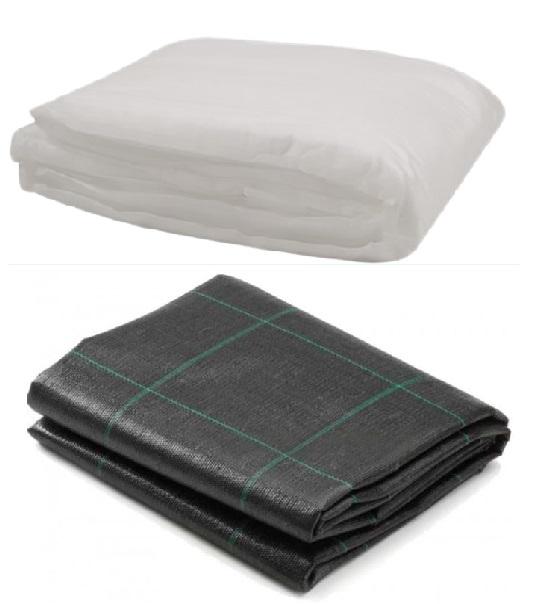
Agrofiber in retail packaging (usually packed in bags), oriented for small areas of homesteads.
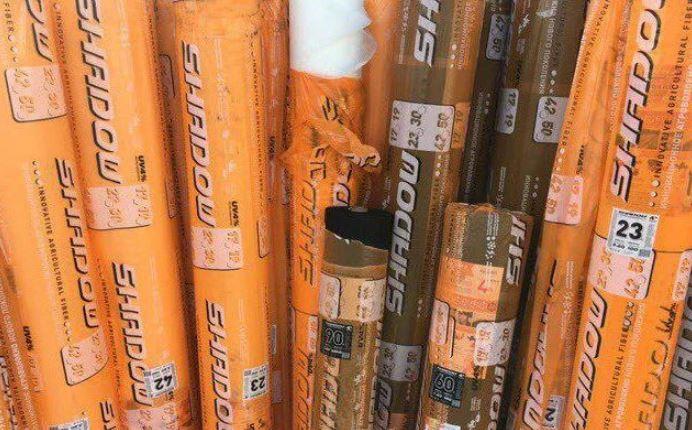
Wholesale packaging of agrofiber in rolls, designed to cover large areas. Also, at retail outlets, you can purchase the necessary density, width and linear length per cut from a roll. Often, this method is even more acceptable, since you can tactilely and visually assess the quality by unfolding the roll. Whereas the retail package, most likely, they won't let you tear it open.
Our agricultural fiber does not require mandatory certification, but each manufacturer includes measurements of such indicators as tensile strength, light transmission, width and length, loss of strength during round-the-clock exposure to special ultraviolet-enriched lamps, and others in the test protocols. You can ask the manufacturer to show these protocols.
It is important to see on the website what equipment the manufacturer works on. Modern, higher-quality speed control and air supply systems, fans of the control system, linear speed and the most modern automation that meet international standards, and therefore the material is of the highest quality.
The most famous brands of agricultural fibers such as "Lutrasil" - the companies "Freudenberg" (Germany), "Agreen" (Italy), "Polispan" (plant "Polymatiz" (Tatarstan), "Plantex" (Poland).
Preparation for covering
In contrast tofilm, which is easy to cut (made a cut - and the scissors go on by themselves), it is more difficult to cut agrofiber due to its non-woven structure (threads are bonded by a thermal method). Because of this, it is better to cut pieces of the required size in a room closed from the wind, at least in two on the beds, as a rule, the section will turn out to be uneven, and the pleasant snow-white piece will quickly become dirty from the wet soil. The best solution is to cut them at the time of purchase. It should be noted that the smallest width is 1.6 m, as in the greenhouse frame, and other options are often proportional to this figure - 3.2 m, 9 m, 12.6 m there are others., яка ріжеться легко (зробив розріз – і враження, що далі ножиці йдуть самі), розрізати агроволокно важче через його нетканну структуру (нитки скріплено термічним способом). Через це краще нарізати шматки потрібного розміру в приміщенні, закритому від вітру, щонайменше удвох. Якщо це робити на грядках самому, як правило, відрізок вийде нерівним, а приємний сніжно-білий шматок швидко стане брудним від вологого ґрунту. Для накривання великих площ найкращим рішенням є їх нарізка під час придбання на підприємстві. При цьому слід зауважити, що найменша ширина буває 1,6 м, як у парникової рами, а інші варіанти часто пропорційні цій цифрі – 3,2 м, 9 м, 12,6 м, хоча бувають й інші.
One of the main advantages of agrofiber is the ability to cover up to 90% of the area of the piece. In the case of the film, a significant part goes to the frame.
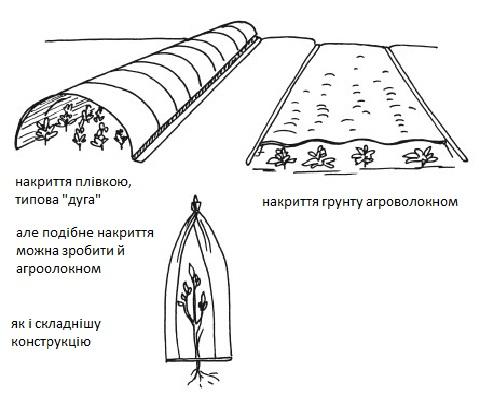
Agrofiber (on the right) does not need a frame, so it is possible to cover a larger area with the same size of the piece as to the film
However, a small margin must be left for fixing the edges and for the growth of the plants. Because of this, the material should not be stretched tightly, like a string. This is its first drawback - the edge will be torn off if it is poorly fixed. In addition, when covering the delicate stairs, the agrofiber is more than 50 g/m2 still needs a light frame (bricks will go, low arcs every 5-10 m), so as not to injure weak plants.
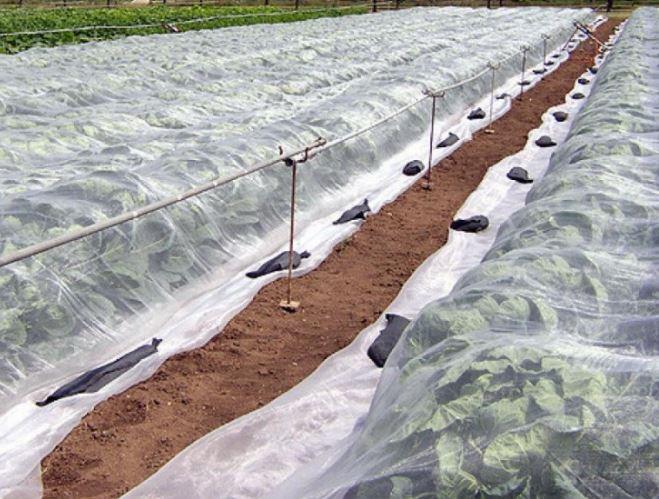
Agrofiber is as light as the plants grow. But for this, the material should not be pulled tightly, like a string (photo from the website http://stroysad.com/).
Compared to a film, agrofibre allows air and water to pass through, allowing plants to "breathe". Therefore, condensation forms under it from the inside much less than under other covering materials, but it still needs to be removed every morning in sunny weather and covered at night when there is a threat of frost. But when watering, it is better to remove it completely, even during rain, because it lets water through, but slowly.
After the season of operation, it is rolled up and put in bags until the next season, stored in dark rooms. Before that, you can wash it and then dry it with slightly warm water. Then it will become snow-white again, as if new.
The second name of the agricultural fiber, which has become popular among the people, is "Spunbond". This word consists of 2 - "bond" (translated from English - "connection"), but the first 4 letters have several versions. One of them is "spun" - an abbreviation, the first letters of the words "synthetic", "polimer", and the prefix "un" indicates a non-woven connection.
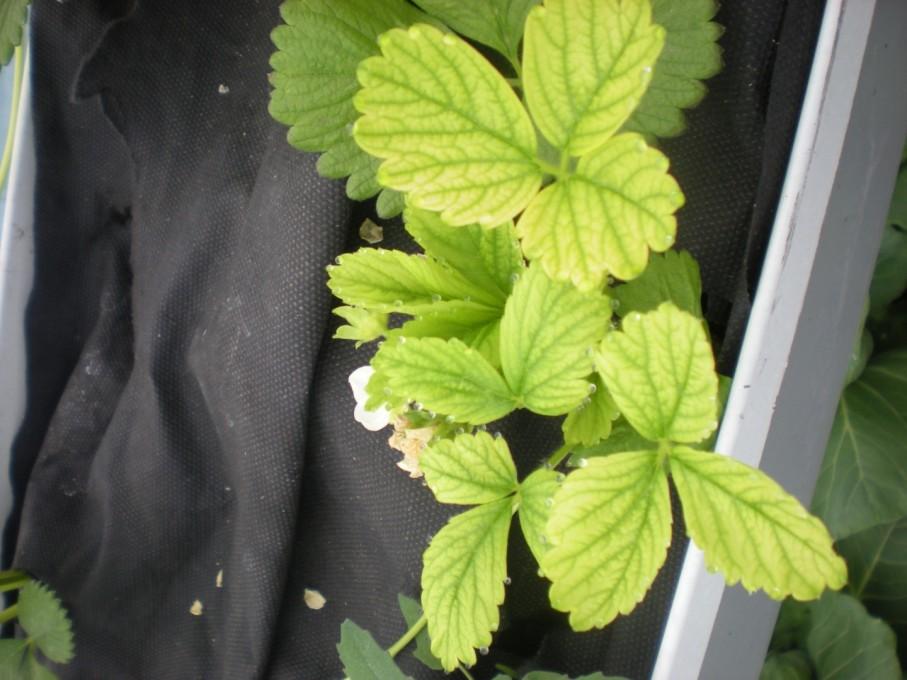
Black agrofiber is used for mulching the zone of rows and between rows and for fast snow melting
Black agrofiber is used for mulching and in cases where fast snow melting is required. The application in this case is known - slits are made in it, spread on the surface of the soil or a bed - and seedlings or planting material are planted in the slits. If you fix the edges, you can forget about the fight against weeds for the entire time of operation.
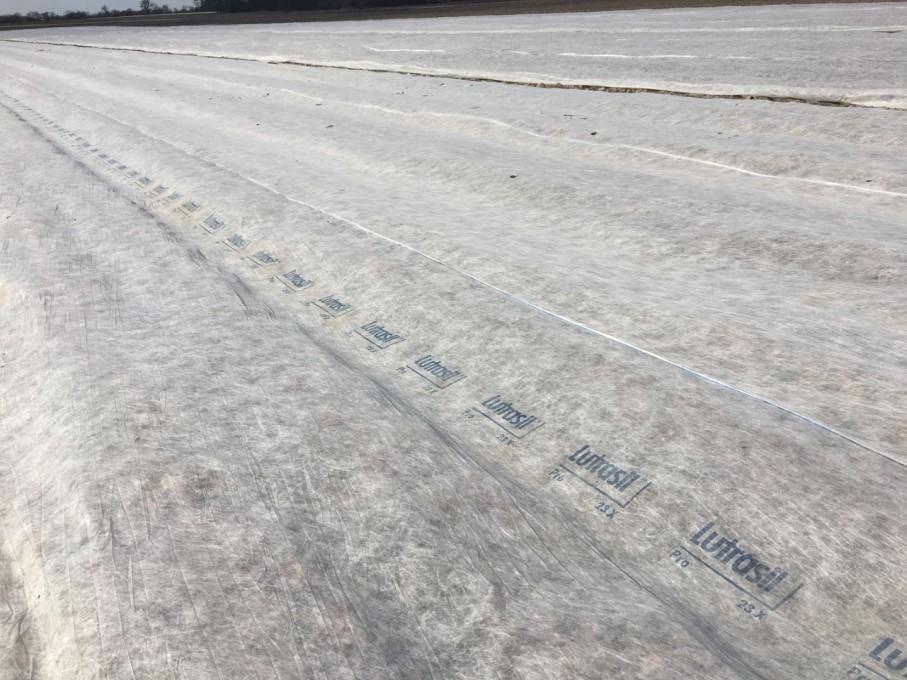
White agrofiber for covering large areas
White is not suitable for this - it lets light through, so weeds will sprout and begin to lift the material as it grows. A black film is also suitable for mulching, but it will have to be removed during the winter - otherwise water drops will tear it when it freezes. But black agrofiber can be left for the winter on perennial crops. If it is equipped with a light stabilizer, it is removed when it begins to break down in the last year of operation.