/ Fertilizers and plant protection products / Complex fertilizers / Fertilizer Redonik BOR - foliar corrector...
Sell / buy
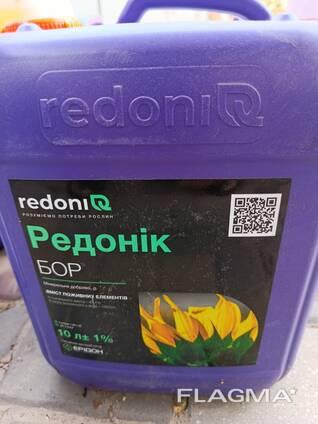
Fertilizer Redonik BOR - foliar corrector of boron deficiency, Kiev region.
Price2050 UAH.
Region:all Ukraine,
Kyiv region.
(Vyshhorodok)
Updated:
Fertilizer Redonik BOR - foliar corrector of boron deficiency in boron-rich crops (oil, technical, leguminous crops, vegetables, fruit crops, berries, grapes, etc.). Contains boron in the fastest and most accessible form for plants - boron-monoethanolamine. It is irreplaceable in highly efficient growing technologies aimed at high yield and high profit per hectare.
Main characteristics
Power elements (boron)
Application method Foliar feeding
Made by redoniQ
Content of the active substance
N (total nitrogen): 65 g/l
In (water-soluble boron): 150 g/l
Preparative form Aqueous solution
Physico-chemical characteristics
Density 1.34-1.37
The pH of the product is 7.0-8.5
Additional characteristics
Storage temperature from +10°С to +30°С
Registration certificate A09420
Packaging of 10 l, the price is indicated for the canister.
The warranty period of storage is 3 years from the date of production.
Application offertilizers
Culture Phase Dose, kg(l)/ha
Maize Maize 5-7 leaves 0.5-1.0
SunflowerSunflower 4-6 leaves, star 1.0-2.0
Sugar beet Sugar beet 4-10 leaves, close the rows, a month before harvesting 1.0-2.0
Soybean Soybean 3-4th trifoliate leaf, budding 1.0-1.5
Pea Pea 3-5 leaves, budding 0.5-1.0
Flax Flax in the "herringbone" phase, in the budding phase 1.0-1.5
Winter rapeseed Winter rapeseed 4-8 leaves, budding 1.0-2.0
Spring rapeseed Spring rapeseed 4-8 leaves, budding 1.0-2.0
Apple tree Apple tree before flowering, 2-3 treatments after flowering with an interval of 14-21 days 1.0-2.0
Pear Pear before flowering, 2-3 treatments after flowering with an interval of 14-21 days 1.0-2.0
Cherry Cherry before flowering, 2-3 treatments after flowering with an interval of 14-21 days 1.0-2.0
Cherry Cherry before flowering, 2-3 treatments after flowering with an interval of 14-21 days 1.0-2.0
Peach Peach before flowering, 2-3 treatments after flowering with an interval of 14-21 days 1.0-2.0
Apricot Apricot before flowering, 2-3 treatments after flowering with an interval of 14-21 days 1.0-2.0
Plum Plum before flowering, 2-3 treatments after flowering with an interval of 14-21 days 1.0-2.0
Potato Potato, the beginning of budding, flowering 1.0-1.5
Tomato Tomato budding beginning 0.5-1.5
Main advantages:
Contains boron in the most quickly accessible form for plants
Contributes to the rapid development of growth points and the strengthening of the formation of generative organs and the formation of the marketable part of the crop.
Increases the synthesis, transport and accumulation of the products of photosynthesis - simple sugars.
Accelerates the recovery of damaged tissues after temperature or chemical exposure (frost, phytotoxicity, etc.).
Application features
Application dose: maximum dose of 2 l/ha
It is recommended: application immediately after creating the tank mixture, without allowing the sprayer to be idle.
The recommended consumption rate of the working solution is 100 l/ha.
Compatibility
The product is compatible with the majority of commonly used PPE, however, it is recommended to test the compatibility of the components of the working solution.
REACOM-CHELATE BORON - a concentrated solution based on organically associated polyborates, intended for use as an environmentally friendly micro-fertilizer for fertilizing agricultural crops sensitive to boron deficiency (rape, sugar beet, sunflower, grapes, etc.).
Features:
B,% - 14.0
N,% - 6,0
type of fertilizer - chelated microfertilizers
Preparative form - solution
Concentrated form of fertilizer - Yes
Minimum temperature of effective action - 5.0 (degrees)(//tractor-service.com)
The maximum temperature of effective action is 25.0 (degrees)
Manufacturer: - Reacom, Ukraine
Container - 20 l canister.
Organically associated polyborates are used as chelating agents for trace elements.
SIGNIFICANCE OF BORON FOR PLANTS.
Plants need boron throughout the growing season, and dicotyledonous plants need it the most. Boron promotes the growth of pollen tubes and pollen germination, increases the number of flowers and fruits, and its absence disrupts the process of seed maturation. Boron has a positive effect on the resistance of plants to fungal, bacterial and viral diseases. In the body of plants, boron regulates the amount of phytohormones - auxins and phenols, controls the overall linear growth and development of tissues. With a lack of boron, the synthesis, transformation and movement of carbohydrates, the formation of reproductive organs, fertilization (pollen sterility) and fruiting of plants are disturbed.
REACOM - BORON CHELATE is used in the fight against boron deficiency and prevention in plants. Root crops, sunflower, legumes, flax, potatoes and vegetable crops are sensitive to the presence of boron in the nutrient medium.
Boron is not utilized in plants, and when it is lacking, young growing organs suffer primarily: growth points die off. So, in the canteen (fodder, sugar) beet, boron deficiency causes the disease "heart rot" and root rot, in potatoes - severe scab damage, in cauliflower - "brown rot".
In fruit crops, boron deficiency is expressed in the crushing of the upper leaves, their twisting and falling, and with a sharp deficiency in the development of "dry tops", in the appearance of liquid ulcers on the fruits (inside and outside), which then turn brown and become corky, and the fruits acquire a characteristic bitter taste.
Boron deficiency most often manifests itself on calcified, especially recalcified, sod-podzolic, sod-silt and gray forest soils, on swampy soils and on soils of light granulometric composition, as well as on developed peatlands. A good supply of plants with phosphorus and calcium increases their demand for boron. In dry years, boron deficiency increases, as the availability of boron for plants decreases with a lack of moisture.
An indicator of a lack of boron in the soil can be a sunflower, which has browning of the top and the cessation of growth of young leaves. Large doses of boron cause general toxicosis in plants, while boron accumulates in the leaves, causing a kind of burn of the lower leaves, i.e. the appearance of marginal necrosis, their yellowing, dying and falling off.
The use of "REAKOM-CHELATE BORA" contributes to:
· Improvement of flowering and pollination
· Strengthening of fruiting processes
· Better development of the root system and leaves
· Increasing resistance to diseases caused by boron deficiency
· Increasing the storage period of the harvest
· Increasing sugar content in sugar beets and grapes
Consumption rates of microfertilizer:
* Agricultural culture - Rate of consumption - Working solution - Terms and goals of processing.
* Sugar beet
-1-3 l/ha
-200-300 l/ha
1. In the phase of 4-6 leaves. To increase sugar content.
2. Before closing the leaves in the rows. To prevent and fight heart rot.
* Rapeseed (winter and spring)
-1-2 l/ha
-200-300 l/ha
1. In the phase of 4-5 leaves. For better root development.
2. Before the beginning of flowering. To increase the number of flowers, improve pollination, uniformity of ripening.
*Sunflower
-1-2 l/ha
-200-300 l/ha
1. In the phase of 4-5 leaves. To improve pollination and increase seed growth.
* Grapes
-1-2 l/ha
-500-800 l/ha
1. Before the beginning of flowering. To improve flowering.
2. Before the beginning of ripening of berries. To prevent diseases caused by boron deficiency, increase the outflow of carbohydrates from leaves.
* Vegetable crops
-0.8-1 l/ha
-300-400 l/ha
-Starting with the phase of 3-4 real leaves with an interval of at least 14-20 days. To improve flowering and pollination, increase fruit formation.
* Fruit trees
-1-2 l/ha
-500-800 l/ha
1. Before flowering. To improve flowering and pollination.
2. After 10-14 days after flowering. To enhance fruit formation.
3. In autumn, before the leaves fall.
* Other cultures
-0.8-1 l/ha
-200-400 l/ha
- When there is insufficient boron with an interval of at least 10-14 days.
Air treatment: Air treatment with the microfertilizer "REACOM-CHELATE BORA" should not exceed 1.5 l/ha with the consumption of the working fluid not less than 50 l/ha.
Drip irrigation: Withdrop irrigation, the norm of consumption and frequency of treatments is similar to foliar feeding (see the table), and the concentration of the drug in the nutrient solution is 50-100 ml/m3 of irrigation water.
Main characteristics
Power elements (boron)
Application method Foliar feeding
Made by redoniQ
Content of the active substance
N (total nitrogen): 65 g/l
In (water-soluble boron): 150 g/l
Preparative form Aqueous solution
Physico-chemical characteristics
Density 1.34-1.37
The pH of the product is 7.0-8.5
Additional characteristics
Storage temperature from +10°С to +30°С
Registration certificate A09420
Packaging of 10 l, the price is indicated for the canister.
The warranty period of storage is 3 years from the date of production.
Application offertilizers
Culture Phase Dose, kg(l)/ha
Maize Maize 5-7 leaves 0.5-1.0
SunflowerSunflower 4-6 leaves, star 1.0-2.0
Sugar beet Sugar beet 4-10 leaves, close the rows, a month before harvesting 1.0-2.0
Soybean Soybean 3-4th trifoliate leaf, budding 1.0-1.5
Pea Pea 3-5 leaves, budding 0.5-1.0
Flax Flax in the "herringbone" phase, in the budding phase 1.0-1.5
Winter rapeseed Winter rapeseed 4-8 leaves, budding 1.0-2.0
Spring rapeseed Spring rapeseed 4-8 leaves, budding 1.0-2.0
Apple tree Apple tree before flowering, 2-3 treatments after flowering with an interval of 14-21 days 1.0-2.0
Pear Pear before flowering, 2-3 treatments after flowering with an interval of 14-21 days 1.0-2.0
Cherry Cherry before flowering, 2-3 treatments after flowering with an interval of 14-21 days 1.0-2.0
Cherry Cherry before flowering, 2-3 treatments after flowering with an interval of 14-21 days 1.0-2.0
Peach Peach before flowering, 2-3 treatments after flowering with an interval of 14-21 days 1.0-2.0
Apricot Apricot before flowering, 2-3 treatments after flowering with an interval of 14-21 days 1.0-2.0
Plum Plum before flowering, 2-3 treatments after flowering with an interval of 14-21 days 1.0-2.0
Potato Potato, the beginning of budding, flowering 1.0-1.5
Tomato Tomato budding beginning 0.5-1.5
Main advantages:
Contains boron in the most quickly accessible form for plants
Contributes to the rapid development of growth points and the strengthening of the formation of generative organs and the formation of the marketable part of the crop.
Increases the synthesis, transport and accumulation of the products of photosynthesis - simple sugars.
Accelerates the recovery of damaged tissues after temperature or chemical exposure (frost, phytotoxicity, etc.).
Application features
Application dose: maximum dose of 2 l/ha
It is recommended: application immediately after creating the tank mixture, without allowing the sprayer to be idle.
The recommended consumption rate of the working solution is 100 l/ha.
Compatibility
The product is compatible with the majority of commonly used PPE, however, it is recommended to test the compatibility of the components of the working solution.
REACOM-CHELATE BORON - a concentrated solution based on organically associated polyborates, intended for use as an environmentally friendly micro-fertilizer for fertilizing agricultural crops sensitive to boron deficiency (rape, sugar beet, sunflower, grapes, etc.).
Features:
B,% - 14.0
N,% - 6,0
type of fertilizer - chelated microfertilizers
Preparative form - solution
Concentrated form of fertilizer - Yes
Minimum temperature of effective action - 5.0 (degrees)(//tractor-service.com)
The maximum temperature of effective action is 25.0 (degrees)
Manufacturer: - Reacom, Ukraine
Container - 20 l canister.
Organically associated polyborates are used as chelating agents for trace elements.
SIGNIFICANCE OF BORON FOR PLANTS.
Plants need boron throughout the growing season, and dicotyledonous plants need it the most. Boron promotes the growth of pollen tubes and pollen germination, increases the number of flowers and fruits, and its absence disrupts the process of seed maturation. Boron has a positive effect on the resistance of plants to fungal, bacterial and viral diseases. In the body of plants, boron regulates the amount of phytohormones - auxins and phenols, controls the overall linear growth and development of tissues. With a lack of boron, the synthesis, transformation and movement of carbohydrates, the formation of reproductive organs, fertilization (pollen sterility) and fruiting of plants are disturbed.
REACOM - BORON CHELATE is used in the fight against boron deficiency and prevention in plants. Root crops, sunflower, legumes, flax, potatoes and vegetable crops are sensitive to the presence of boron in the nutrient medium.
Boron is not utilized in plants, and when it is lacking, young growing organs suffer primarily: growth points die off. So, in the canteen (fodder, sugar) beet, boron deficiency causes the disease "heart rot" and root rot, in potatoes - severe scab damage, in cauliflower - "brown rot".
In fruit crops, boron deficiency is expressed in the crushing of the upper leaves, their twisting and falling, and with a sharp deficiency in the development of "dry tops", in the appearance of liquid ulcers on the fruits (inside and outside), which then turn brown and become corky, and the fruits acquire a characteristic bitter taste.
Boron deficiency most often manifests itself on calcified, especially recalcified, sod-podzolic, sod-silt and gray forest soils, on swampy soils and on soils of light granulometric composition, as well as on developed peatlands. A good supply of plants with phosphorus and calcium increases their demand for boron. In dry years, boron deficiency increases, as the availability of boron for plants decreases with a lack of moisture.
An indicator of a lack of boron in the soil can be a sunflower, which has browning of the top and the cessation of growth of young leaves. Large doses of boron cause general toxicosis in plants, while boron accumulates in the leaves, causing a kind of burn of the lower leaves, i.e. the appearance of marginal necrosis, their yellowing, dying and falling off.
The use of "REAKOM-CHELATE BORA" contributes to:
· Improvement of flowering and pollination
· Strengthening of fruiting processes
· Better development of the root system and leaves
· Increasing resistance to diseases caused by boron deficiency
· Increasing the storage period of the harvest
· Increasing sugar content in sugar beets and grapes
Consumption rates of microfertilizer:
* Agricultural culture - Rate of consumption - Working solution - Terms and goals of processing.
* Sugar beet
-1-3 l/ha
-200-300 l/ha
1. In the phase of 4-6 leaves. To increase sugar content.
2. Before closing the leaves in the rows. To prevent and fight heart rot.
* Rapeseed (winter and spring)
-1-2 l/ha
-200-300 l/ha
1. In the phase of 4-5 leaves. For better root development.
2. Before the beginning of flowering. To increase the number of flowers, improve pollination, uniformity of ripening.
*Sunflower
-1-2 l/ha
-200-300 l/ha
1. In the phase of 4-5 leaves. To improve pollination and increase seed growth.
* Grapes
-1-2 l/ha
-500-800 l/ha
1. Before the beginning of flowering. To improve flowering.
2. Before the beginning of ripening of berries. To prevent diseases caused by boron deficiency, increase the outflow of carbohydrates from leaves.
* Vegetable crops
-0.8-1 l/ha
-300-400 l/ha
-Starting with the phase of 3-4 real leaves with an interval of at least 14-20 days. To improve flowering and pollination, increase fruit formation.
* Fruit trees
-1-2 l/ha
-500-800 l/ha
1. Before flowering. To improve flowering and pollination.
2. After 10-14 days after flowering. To enhance fruit formation.
3. In autumn, before the leaves fall.
* Other cultures
-0.8-1 l/ha
-200-400 l/ha
- When there is insufficient boron with an interval of at least 10-14 days.
Air treatment: Air treatment with the microfertilizer "REACOM-CHELATE BORA" should not exceed 1.5 l/ha with the consumption of the working fluid not less than 50 l/ha.
Drip irrigation: Withdrop irrigation, the norm of consumption and frequency of treatments is similar to foliar feeding (see the table), and the concentration of the drug in the nutrient solution is 50-100 ml/m3 of irrigation water.
|
Shop, contacts | |
Yuriy / отзывы, инфо. / activity evaluation | |
|
Phone:
+38(xxxxxx
show
| |
All ads user ~1000 | |
Ad ID: #921924
(added by a registered user, registration date: 08-10-2016)
Added / Updated: 09-22-2026 10:04 (relevant, until: 09-22-2027)
Permanent ad address:
Showed / watched for today: ?, total: ?
Similar ads
Among them there are many interesting ones...