/ Seeds, seedlings and sowing materials / Various seeds, seedlings and sowing materials + in assortment / VIRYD SC 375 - systemic action fungicide for protection...
For sale / buy
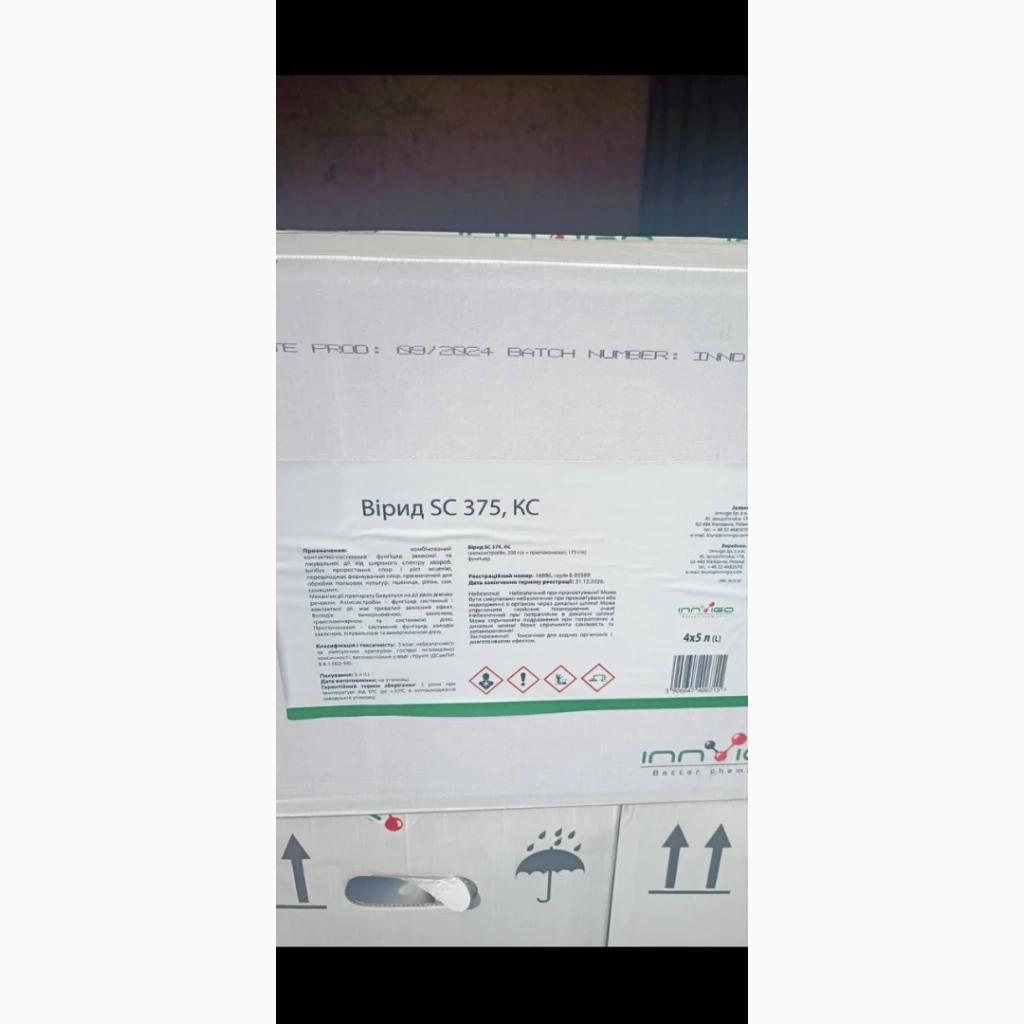
VIRYD SC 375 - systemic fungicide actions for the protection of grain crops, rapeseed, sunflower, etc., Kyiv region.
Price4500 UAH.
Region:all Ukraine,
Kyiv region.
(Vyshhorodok)
Updated:
VIRID SC 375 is a fungicide of systemic action in the form of a suspension concentrate for the protection ofcereals crops, rapeseed,sunflower and soybeans against pathogens of fungal diseases.
It contains a fungicidal combination of the most powerful triazole-proteoconazole with a high content of the active substance and the fastest strobilurin, namely azoxystrobin.
Active ingredients: Prothioconazole, Azoxystrobin.
Preparative form: Suspension concentrate
Chemical class: triazolinthiones, strobilurins
Concentration of active substances:
azoxystrobin - 200 g/l + prothioconazole - 175 g/l
For crops: corn, soybean, sunflower, rapeseed
Manufacturer: INNVIGO
Packaging: 20l box, 4 canisters of 5l each, the price is per canister.
Advantages:
Effective - Provides reliable protection of crops against the most harmful diseases
Protective effect - Improves nitrogen assimilation, enhances photosynthesis and helps to increase the weight of a thousand seeds.
Therapeutic effect - Strengthens the immunity of plants, increases their resistance to stress and ensures active growth due to the "green leaf effect".
Mechanism of action:
Azoxystrobin inhibits mitochondrial respiration of pathogen cells. Suppresses the germination of spores and conidia, the initial growth of mycelium and prevents the formation of spores, blocks the accumulation of ethylene in cultures. Prothioconazole inhibits the development of hyphae and mycelium by disrupting the process of biosynthesis of sterols in the cell membrane. The presence of two active substances together with a different mechanism of action prevents the emergence of resistance of pathogens to the drug, disrupts the biosynthesis of ergosterol in the pathogen.
The spectrum of action of the drug:
Alternaria, fomosis, rust, septoriosis, anthracnose, powdery mildew, fusarium, brittleness of stems, cylindrosporiosis, white spot, sclerotiniosis, gray rot, net spot, rhynchosporiosis, etc.
Application
Terms of submission
Cereals: From the beginning of emergence into the tube until the end of flowering.
Sunflower: Processing at the first signs of the disease or in the phase of 6–8 leaves — preventively.
Rapak: Spraying during the growing season.
Soy: Processing at the first signs of the disease either preventively or in the phase of full flowering.
Optimum application temperature: 11°C...+25°C
Rate of use: 0.5-1.0 l/ha(//tractor-service.com)
The consumption rate of the working solution: 200-400 l/ha
Optimal water pH: 5.0-7.0
Compatibility
Compatible with most pesticides. However, preliminary mixing is recommended in each individual case.
For better efficiency, we recommend using such products as Metcon 100 BP, Los Delmetros 280 KS, Mapik 300 RK.
Disclaimer
It is not recommended to use on weakened crops that have been stressed due to adverse conditions, such as frost, heat, drought, etc.
Beetroot sugar Veda from Strube
Manufacturer; Strube
Registered for growing in all zones of Ukraine (Polyssia, Forest Steppe, Steppe), resistant to rhizomania, suitable for industrial crops.
The main characteristics of the Ved hybrid:
Maturity group: Early ripe, which allows you to start harvesting earlier.
Type: Z-type (sugary), provides high yield of sugar per hectare.
Productivity: In production conditions, it shows results from 72 to 96 t/ha, with the potential of more than 7 t/ha.
Sugar content: High, usually over 17%.
Resistance: High resistance to rhizomania - 8 points.
Resistance of the Veda hybrid to diseases and stress factors
The type of hybrid is diploid, Z-type. It has a very high processability (juice purity), with a low content of α-N (alpha amino nitrogen). Excellent field similarity.
You can dig during the entire beet harvesting campaign.
The Ved hybrid is a popular choice due to its stability and adaptability to the conditions of Ukraine.
It contains a fungicidal combination of the most powerful triazole-proteoconazole with a high content of the active substance and the fastest strobilurin, namely azoxystrobin.
Active ingredients: Prothioconazole, Azoxystrobin.
Preparative form: Suspension concentrate
Chemical class: triazolinthiones, strobilurins
Concentration of active substances:
azoxystrobin - 200 g/l + prothioconazole - 175 g/l
For crops: corn, soybean, sunflower, rapeseed
Manufacturer: INNVIGO
Packaging: 20l box, 4 canisters of 5l each, the price is per canister.
Advantages:
Effective - Provides reliable protection of crops against the most harmful diseases
Protective effect - Improves nitrogen assimilation, enhances photosynthesis and helps to increase the weight of a thousand seeds.
Therapeutic effect - Strengthens the immunity of plants, increases their resistance to stress and ensures active growth due to the "green leaf effect".
Mechanism of action:
Azoxystrobin inhibits mitochondrial respiration of pathogen cells. Suppresses the germination of spores and conidia, the initial growth of mycelium and prevents the formation of spores, blocks the accumulation of ethylene in cultures. Prothioconazole inhibits the development of hyphae and mycelium by disrupting the process of biosynthesis of sterols in the cell membrane. The presence of two active substances together with a different mechanism of action prevents the emergence of resistance of pathogens to the drug, disrupts the biosynthesis of ergosterol in the pathogen.
The spectrum of action of the drug:
Alternaria, fomosis, rust, septoriosis, anthracnose, powdery mildew, fusarium, brittleness of stems, cylindrosporiosis, white spot, sclerotiniosis, gray rot, net spot, rhynchosporiosis, etc.
Application
Terms of submission
Cereals: From the beginning of emergence into the tube until the end of flowering.
Sunflower: Processing at the first signs of the disease or in the phase of 6–8 leaves — preventively.
Rapak: Spraying during the growing season.
Soy: Processing at the first signs of the disease either preventively or in the phase of full flowering.
Optimum application temperature: 11°C...+25°C
Rate of use: 0.5-1.0 l/ha(//tractor-service.com)
The consumption rate of the working solution: 200-400 l/ha
Optimal water pH: 5.0-7.0
Compatibility
Compatible with most pesticides. However, preliminary mixing is recommended in each individual case.
For better efficiency, we recommend using such products as Metcon 100 BP, Los Delmetros 280 KS, Mapik 300 RK.
Disclaimer
It is not recommended to use on weakened crops that have been stressed due to adverse conditions, such as frost, heat, drought, etc.
Beetroot sugar Veda from Strube
Manufacturer; Strube
Registered for growing in all zones of Ukraine (Polyssia, Forest Steppe, Steppe), resistant to rhizomania, suitable for industrial crops.
The main characteristics of the Ved hybrid:
Maturity group: Early ripe, which allows you to start harvesting earlier.
Type: Z-type (sugary), provides high yield of sugar per hectare.
Productivity: In production conditions, it shows results from 72 to 96 t/ha, with the potential of more than 7 t/ha.
Sugar content: High, usually over 17%.
Resistance: High resistance to rhizomania - 8 points.
Resistance of the Veda hybrid to diseases and stress factors
The type of hybrid is diploid, Z-type. It has a very high processability (juice purity), with a low content of α-N (alpha amino nitrogen). Excellent field similarity.
You can dig during the entire beet harvesting campaign.
The Ved hybrid is a popular choice due to its stability and adaptability to the conditions of Ukraine.
|
Shop, contacts | |
Юрий / отзывы, инфо. / оценка activities | |
|
Phone:
+38(xxxxxx
показать
| |
All user ads ~1000 | |
Ad ID: #921237
(added by a registered user, registration date: 10-08-2016)
Added/Updated: 21-09-2026 09:28 (current, until: 09-21-2027)
Permanent ad address:
Showed / watched for today: ?, total: ?
Similar ads
Among them there are many interesting...