/ Fertilizers and plant protection products / Protraviteli / Vitavax - combined fungicidal poison...
Продам / купить
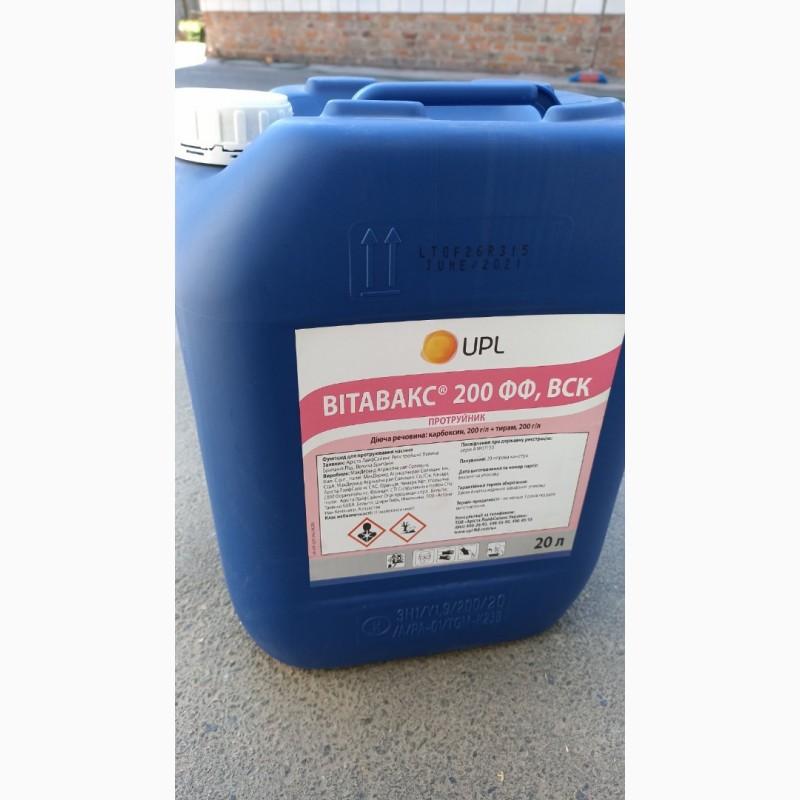
Vitavax - combined fungicidal poisoner of cereal, corn, flax, pea seeds, Kievskaya region.
Price6.75$
Region:all of Ukraine,
Kiev region.
(Vyshhorodok)
Updated:
Vitavax® - Combined liquid fungicidal seed poison with contact and systemic fungicidal action against a wide range of diseases on many crops.
Active substances: carboxin, 200 g/l + thiram, 200 g/l
Preparative form: water-suspension concentrate
Country of manufacture: England
Packaging: 20 l canister, the price is for 1 l.
Advantages of Vitavax®:
- Powerful synergistic effect of systemic and contact active substances.
-Perfect control of a wide range of diseases
-Contributes to obtaining a friendly ladder of culture.
-Element of anti-resistance strategy
-Control of resistant strains of fusarium.
Vitavax® is an antidote that provides highly effective control of seed-borne and soil-borne pathogens. Vitavax is easy to use and safe for seeds.
Mechanism of action of Vitavax®:
Two active ingredients provide control of a wide range of seed-borne and soil-borne diseases: Carboxin is a systemic fungicide from the SDHI group that is absorbed into the tissues of the grain and seedling, protecting them both from pathogens on the surface of the grain and from pathogens that may be inside it. Carboxin has well proven itself as one of the most effective systemicfungicides for the fight against flying soot and other diseases, the causative agents of which are transferred during flowering and remain inside the plant in a state of rest until germination.
Thiram is a broad-spectrum contact fungicide that controls pathogens that are on the surface of seeds and in the soil. By diffusion over a short distance around the processed grain, tyram forms a protective zone in the soil, which serves as a barrier against fungal infection and protects seeds and seedlings from root rot. Due to its broad spectrum of action and high efficiency, thiram is one of the most widely used contact fungicides for seed treatment in the world.
Regulations on the use of Vitavax®:
(//tractor-service.com)
Culture, treated object - Rate of consumption, l/t of seeds - Harmful organism against which it is treated - Method, time of treatment
= Spring and winter wheat 2.5-3.0 Volatile, hard soot, root rot, mold of seeds. = Spring and winter barley 2.5-3.0 Volatile, hard soot, root rot, seed mold Seed treatment with drug suspension, working solution rate - up to 10 l/t = Spring and winter rye 2.5-3.0 Volatile, stem soot, root rot, snow mold Seed treatment with a suspension of the drug, the rate of the working solution - up to 10 l/t
= Ячмінь ярий та озимий 2,5-3,0 Летюча, тверда сажка, кореневі гнилі, пліснявіння насіння Протруювання насіння суспензією препарату, норма робочого розчину – до 10 л/т
= Жито яре та озиме 2,5-3,0 Летюча, стеблова сажка, кореневі гнилі, снігова пліснява Протруювання насіння суспензією препарату, норма робочого розчину – до 10 л/т
= Corn 2.5-3.0 Volatile, bubbly soot, root and stem rot, seed mold Seed treatment with a suspension of the drug, the rate of the working solution - 6-8 l/t
= Flax (for technical purposes) 1.5-2.0 Anthracnose, spotting Seed treatment with a suspension of the drug, the rate of the working solution - 3-5 l/t
= Peas 2.5 Root rot Treatment of seeds with a suspension of the drug, the rate of the working solution is up to 10 l/t.
Special characteristics
• One of the active ingredients of Vitavax®, Karboxin®, is patented as aplant growth regulator in the USA.
• Its action is manifested in four directions: it stimulates the process of germination, contributes to the elongation of the coleoptile, ensures improved formation of the stem and healthy development.
root system.
• Thanks to these properties, the drug helps to successfully overcome adverse conditions during germination, ensuring healthy and uniform seedlings.
• Its use helps to overcome difficulties associated with late sowing, sowing at a greater depth, sowing in cold, dry, wet, infertile or depleted soil.
• Pre-sowing soil preparation is also not critical.
• Preparative forms of the drug Vitavax® are registered and used in more than 120 countries of the world, on more than 30 cultures, against the causative agents of more than 30 diseases.
• More than 100 scientific experiments in different countries of the world have shown an increase in yield by an average of 10% compared to non-poisoned seeds (control).
Active substances: carboxin, 200 g/l + thiram, 200 g/l
Preparative form: water-suspension concentrate
Country of manufacture: England
Packaging: 20 l canister, the price is for 1 l.
Advantages of Vitavax®:
- Powerful synergistic effect of systemic and contact active substances.
-Perfect control of a wide range of diseases
-Contributes to obtaining a friendly ladder of culture.
-Element of anti-resistance strategy
-Control of resistant strains of fusarium.
Vitavax® is an antidote that provides highly effective control of seed-borne and soil-borne pathogens. Vitavax is easy to use and safe for seeds.
Mechanism of action of Vitavax®:
Two active ingredients provide control of a wide range of seed-borne and soil-borne diseases: Carboxin is a systemic fungicide from the SDHI group that is absorbed into the tissues of the grain and seedling, protecting them both from pathogens on the surface of the grain and from pathogens that may be inside it. Carboxin has well proven itself as one of the most effective systemicfungicides for the fight against flying soot and other diseases, the causative agents of which are transferred during flowering and remain inside the plant in a state of rest until germination.
Thiram is a broad-spectrum contact fungicide that controls pathogens that are on the surface of seeds and in the soil. By diffusion over a short distance around the processed grain, tyram forms a protective zone in the soil, which serves as a barrier against fungal infection and protects seeds and seedlings from root rot. Due to its broad spectrum of action and high efficiency, thiram is one of the most widely used contact fungicides for seed treatment in the world.
Regulations on the use of Vitavax®:
(//tractor-service.com)
Culture, treated object - Rate of consumption, l/t of seeds - Harmful organism against which it is treated - Method, time of treatment
= Spring and winter wheat 2.5-3.0 Volatile, hard soot, root rot, mold of seeds. = Spring and winter barley 2.5-3.0 Volatile, hard soot, root rot, seed mold Seed treatment with drug suspension, working solution rate - up to 10 l/t = Spring and winter rye 2.5-3.0 Volatile, stem soot, root rot, snow mold Seed treatment with a suspension of the drug, the rate of the working solution - up to 10 l/t
= Ячмінь ярий та озимий 2,5-3,0 Летюча, тверда сажка, кореневі гнилі, пліснявіння насіння Протруювання насіння суспензією препарату, норма робочого розчину – до 10 л/т
= Жито яре та озиме 2,5-3,0 Летюча, стеблова сажка, кореневі гнилі, снігова пліснява Протруювання насіння суспензією препарату, норма робочого розчину – до 10 л/т
= Corn 2.5-3.0 Volatile, bubbly soot, root and stem rot, seed mold Seed treatment with a suspension of the drug, the rate of the working solution - 6-8 l/t
= Flax (for technical purposes) 1.5-2.0 Anthracnose, spotting Seed treatment with a suspension of the drug, the rate of the working solution - 3-5 l/t
= Peas 2.5 Root rot Treatment of seeds with a suspension of the drug, the rate of the working solution is up to 10 l/t.
Special characteristics
• One of the active ingredients of Vitavax®, Karboxin®, is patented as aplant growth regulator in the USA.
• Its action is manifested in four directions: it stimulates the process of germination, contributes to the elongation of the coleoptile, ensures improved formation of the stem and healthy development.
root system.
• Thanks to these properties, the drug helps to successfully overcome adverse conditions during germination, ensuring healthy and uniform seedlings.
• Its use helps to overcome difficulties associated with late sowing, sowing at a greater depth, sowing in cold, dry, wet, infertile or depleted soil.
• Pre-sowing soil preparation is also not critical.
• Preparative forms of the drug Vitavax® are registered and used in more than 120 countries of the world, on more than 30 cultures, against the causative agents of more than 30 diseases.
• More than 100 scientific experiments in different countries of the world have shown an increase in yield by an average of 10% compared to non-poisoned seeds (control).
|
Shop, contacts | |
Yuriy / отзывы, инфо./ оценка activities | |
|
Telephone:
+38(xxxxxx
показать
| |
All user ads ~1000 | |
Ad ID: #734684
(added by a registered user, registration date: 08-10-2016)
Added / Updated: 09-22-2026 10:34 (current, until: 09-22-2027)
Permanent ad address:
Showed / watched for today: ?, total: ?
Similar ads
Among them there are many interesting ones...