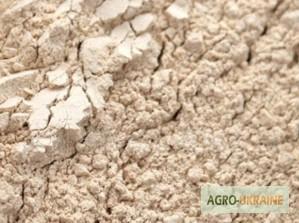
For sale / buy
Magnesite caustic PMK 87, Dnepropetrovsk region.
Region:
Dnepropetrovsk region.
(G Zaporozhye Makarenko 13)
Magnesite powder caustic brand DTMR 84.87 TT 72664728-077-2008.
Analogue of caustic magnesite PMK-84,87 GOST 1216-87. For special purpose, for chemical, energy, glass and other industries.
Caustic magnesite is an air-binding substance obtained by burning natural magnesite with subsequent grinding of the product into a fine powder.
(//tractor-service.com)
During the firing process, the main component of magnesite is magnesium carbonate (MgCO3), which decomposes into magnesium oxide (MgO) and carbon dioxide (CO2). Firing is carried out at a temperature higher than the decomposition temperature of magnesite (550 °C), but lower than its sintering temperature. Usually, the firing temperature is 800-850 °C. The caustic magnesite obtained in this way is subsequently ground in ball mills. And as a result, a caustic powder is formed, which, according to GOST, is divided into three classes depending on its chemical composition. The powder of the first class is intended for the chemical industry, and the second and third - used in construction, as a binding material.
At the same time, it is necessary to take into account that caustic magnesite is not sealed with water (since in this case it has low strength), but with a solution of magnesium chloride, magnesium sulfate, or some other salts. Caustic magnesite closed with a solution of salts is called magnesia cement or Sorel cement. Which is used for the production of xylolite and fibrolite, as well as for the production of plaster solutions, heat-insulating materials, artificial marble, artificial millstones and some other products.
The strength of solutions of caustic magnesite reaches 1000kg/cm2. The strength of magnesium concrete reaches 30-50% in 1 day, and 60-90% of the maximum strength in 7 days. Magnesium binder has very high adhesion.
Produced by OJSC "Kombinat "Magnesite" (Satka, Chelyabinsk region, Russian Federation).
Analogue of caustic magnesite PMK-84,87 GOST 1216-87. For special purpose, for chemical, energy, glass and other industries.
Caustic magnesite is an air-binding substance obtained by burning natural magnesite with subsequent grinding of the product into a fine powder.
(//tractor-service.com)
During the firing process, the main component of magnesite is magnesium carbonate (MgCO3), which decomposes into magnesium oxide (MgO) and carbon dioxide (CO2). Firing is carried out at a temperature higher than the decomposition temperature of magnesite (550 °C), but lower than its sintering temperature. Usually, the firing temperature is 800-850 °C. The caustic magnesite obtained in this way is subsequently ground in ball mills. And as a result, a caustic powder is formed, which, according to GOST, is divided into three classes depending on its chemical composition. The powder of the first class is intended for the chemical industry, and the second and third - used in construction, as a binding material.
At the same time, it is necessary to take into account that caustic magnesite is not sealed with water (since in this case it has low strength), but with a solution of magnesium chloride, magnesium sulfate, or some other salts. Caustic magnesite closed with a solution of salts is called magnesia cement or Sorel cement. Which is used for the production of xylolite and fibrolite, as well as for the production of plaster solutions, heat-insulating materials, artificial marble, artificial millstones and some other products.
The strength of solutions of caustic magnesite reaches 1000kg/cm2. The strength of magnesium concrete reaches 30-50% in 1 day, and 60-90% of the maximum strength in 7 days. Magnesium binder has very high adhesion.
Produced by OJSC "Kombinat "Magnesite" (Satka, Chelyabinsk region, Russian Federation).
Ad ID: #428531
(added by a registered user)
Permanent ad address:
Showed / watched for today: ?, total: ?
Similar fresh ads
Among them there are many interesting ones...