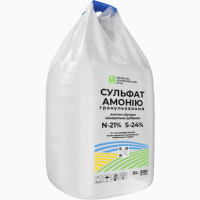
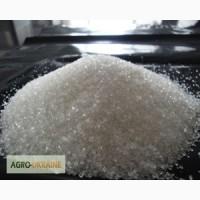
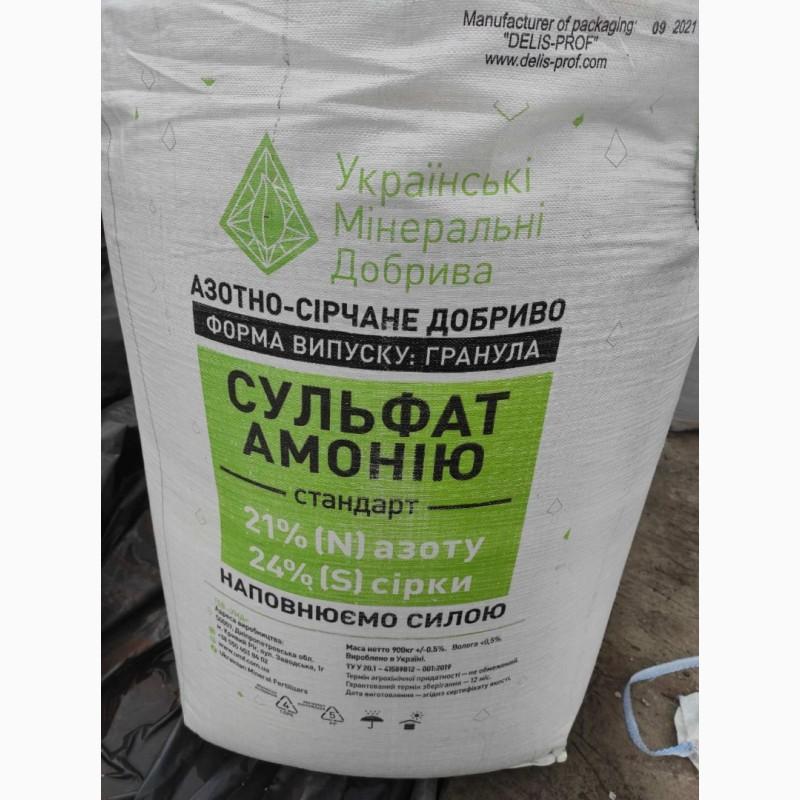
/ Fertilizers and plant protection products / Nitrogen fertilizers / Fertilizer Ammonium sulfate granule( Netherlands)
For sale / buy
Fertilizer Sulphate of Ammonia granule (Netherlands), Dnipropetrovsk region.
Price14,400 UAH.
Region:all of Ukraine,
Dnepropetrovsk region.
(Synelnikovo)
Updated:
Sulfate Ammonia is best used as a basic fertilizer with a seal to the depth of the roots on neutral and alkaline soils. Use on acidic, podzolic soils is undesirable due to the presence of free sulfuric acid.
Fertilizer is applied to all crops, especially from the cruciferous family, rapeseed,cabbage, legumes, rice, which respond well to sulfur.
Ammonium sulfate introduced into the soil quickly dissolves and immediately enters into exchange reactions with the cations of the solid phase of the soil. A significant part of NH4+ cations from dissolved in the soilfertilizer is included in the soil absorbing complex, and an equivalent amount of other cations passes into the solution. Absorbed ammonium is absorbed by plants.
(//tractor-service.com)
At the same time, being in an absorbed state, the ammonium ion becomes weakly mobile, which can lead to the localization of ammonia nitrogen in the center of application and lead to plant burns.
Sulfur in fertilizer is in the form of sulfate ions SO4— — available for plants.
Fertilizer dissolves easily in water. In a dry state, it has good physical properties: it does not stick well during storage, it is well dispersed by a seed drill. It has moderate hygroscopicity. Preserves friability in the air.
With long-term use ofammonium sulfate, liming of the soil is periodically carried out by adding materials containing Ca and Mg carbonates (limestone, chalk, marl, dolomite), or quicklime and slaked lime, etc.
Fertilizer is applied to all crops, especially from the cruciferous family, rapeseed,cabbage, legumes, rice, which respond well to sulfur.
Ammonium sulfate introduced into the soil quickly dissolves and immediately enters into exchange reactions with the cations of the solid phase of the soil. A significant part of NH4+ cations from dissolved in the soilfertilizer is included in the soil absorbing complex, and an equivalent amount of other cations passes into the solution. Absorbed ammonium is absorbed by plants.
(//tractor-service.com)
At the same time, being in an absorbed state, the ammonium ion becomes weakly mobile, which can lead to the localization of ammonia nitrogen in the center of application and lead to plant burns.
Sulfur in fertilizer is in the form of sulfate ions SO4— — available for plants.
Fertilizer dissolves easily in water. In a dry state, it has good physical properties: it does not stick well during storage, it is well dispersed by a seed drill. It has moderate hygroscopicity. Preserves friability in the air.
With long-term use ofammonium sulfate, liming of the soil is periodically carried out by adding materials containing Ca and Mg carbonates (limestone, chalk, marl, dolomite), or quicklime and slaked lime, etc.
|
Author, contacts | |
OOO "TD "Svarog Agro" / отзывы, инфо. / activity evaluation | |
|
Phone:
+38(xxxxxx
show
| |
All ads пользователя ~182 | |
Ad ID: #1165138
(added by a registered user, registration date: 22-01-2016)
Added / Updated: 14-01-2026 11:29 (relevant, until: 14-01-2027)
Permanent ad address:
Showed / watched for today: ?, total: ?