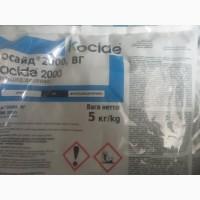
/ Fertilizers and plant protection products / Fungicides / Fungicide Koside 2000 for sale, VG, 5 kg., Korteva

For sale / buy
For sale Fungicide Koside 2000, VG, 5 kg., Korteva, Cherkassy region.
Region:
Cherkasskaya region.
(Sosnivskyi district PROSPECT KHIMIKIV building 59 office)
Modern fungicide-bactericide based on copper to protect garden, vegetable and field crops from a complex of diseases
Maximum bioavailable copper!
Increased efficiency thanks to the maximum amount of bioavailable copper
Instant solubility of granules in the working solution due to high-tech formulation.
Longer action due to the formation of a protective film on the plant and the reactivation effect
Active substance:...........copper hydroxide - 538 g / kg
Preform:................water-soluble granules
Chemical class:............inorganiccopper-containing fungicides
Packaging: 5 kg
Rate of use:.......1.5 - 6.0 kg / ha
Koside® 2000 protects plants prophylactically from diseases of bacterial and fungal origin.
Fungicide, after prophylactic use,
protects field crops such as soybeans and also
orchards andvegetables from various
diseases of bacterial origin.
Koside® 2000 protects against a wide range of diseases of fungal origin. including ascomycetes, oomycetes.
That is why Koside® 2000 is an indispensable contact preparation in the protection systems of many cultures..
Koside® 2000 is produced in a modern form - copper hydroxide and the latest formulation - water-soluble.
pellets, which allows:
easily and quickly dissolve in water;(//tractor-service.com)
to form a protective film on the surface of the leaves, which|167
разом із оптимальним розміром часток залишає
Coside® 2000 on the work surface and improves
resistance of the fungicide to being washed away by precipitation;
Excellent compatibility with other drugs;
Mechanism of action
Koside® 2000 is a contact fungicide based on copper hydroxide, which provides a protective preventive effect against the causative agents of scab, spotting, late blight, alternariosis, anthracnose and other diseases on a wide range of crops. It is also characterized by a bacterial effect - it is effective against bacterial spots.
Koside® 2000 creates a protective layer that prevents the penetration of pathogens into plants. Crystals of metallic copper adhere to the surface of the treated leaves and, during contact with water, divalent copper ions are released and become active against the target pathogens.
After contact with the treated surface, spores and bacteria quickly absorb divalent copper ions, and as soon as the toxic concentration in the middle of the cell is reached, the infection process stops.
Divalent copper ions affect several key life processes of pathogens: the structure of proteins, the functioning of various enzymes, electron transport systems, and cell membranes. Thanks to the preventive activity and the multifaceted effect of the drug on the body of the pathogen, a high the effectiveness of its action, at the same time, the risk of the appearance of resistance is low.
ефективність його дії, водночас ризик появи резистентності є низьким.
What is the difference between fungicides containing copper?
First of all, the most important thing for a copper-based fungicide is the chemical form of copper on which the fungicide is made (sulfate, oxychloride, hydroxide, etc.), as well as the formulation (z.p., v.g., k.s., size of constituent parts of the active substance,adhesives, etc.). The most biologically effective of all forms of copper is copper hydroxide (Coside® 2000). It is copper hydroxide that is characterized by the fastest onset of action on the pathogen, excellent persistence (stability on the plant) and the highest level of biologically active Cu2 ions
+ for successful protection of plants from pathogens.
Not all copper-based drugs are the same!
A new, unique principle of the presence of two types of Cu2+ ions is used in the Koside® 2000 fungicide.
The formulation contains both strong chemical structures of copper hydroxide and unstable copper-containing compounds.
Copper is in the preparation in a complex polymerized form, which regulates the breakdown of unstable Cu2+ ions,
and at the same time reduces the risk of plant intoxication to a minimum.
Maximum bioavailable copper!
Increased efficiency thanks to the maximum amount of bioavailable copper
Instant solubility of granules in the working solution due to high-tech formulation.
Longer action due to the formation of a protective film on the plant and the reactivation effect
Active substance:...........copper hydroxide - 538 g / kg
Preform:................water-soluble granules
Chemical class:............inorganiccopper-containing fungicides
Packaging: 5 kg
Rate of use:.......1.5 - 6.0 kg / ha
Koside® 2000 protects plants prophylactically from diseases of bacterial and fungal origin.
Fungicide, after prophylactic use,
protects field crops such as soybeans and also
orchards andvegetables from various
diseases of bacterial origin.
Koside® 2000 protects against a wide range of diseases of fungal origin. including ascomycetes, oomycetes.
That is why Koside® 2000 is an indispensable contact preparation in the protection systems of many cultures..
Koside® 2000 is produced in a modern form - copper hydroxide and the latest formulation - water-soluble.
pellets, which allows:
easily and quickly dissolve in water;(//tractor-service.com)
to form a protective film on the surface of the leaves, which|167
разом із оптимальним розміром часток залишає
Coside® 2000 on the work surface and improves
resistance of the fungicide to being washed away by precipitation;
Excellent compatibility with other drugs;
Mechanism of action
Koside® 2000 is a contact fungicide based on copper hydroxide, which provides a protective preventive effect against the causative agents of scab, spotting, late blight, alternariosis, anthracnose and other diseases on a wide range of crops. It is also characterized by a bacterial effect - it is effective against bacterial spots.
Koside® 2000 creates a protective layer that prevents the penetration of pathogens into plants. Crystals of metallic copper adhere to the surface of the treated leaves and, during contact with water, divalent copper ions are released and become active against the target pathogens.
After contact with the treated surface, spores and bacteria quickly absorb divalent copper ions, and as soon as the toxic concentration in the middle of the cell is reached, the infection process stops.
Divalent copper ions affect several key life processes of pathogens: the structure of proteins, the functioning of various enzymes, electron transport systems, and cell membranes. Thanks to the preventive activity and the multifaceted effect of the drug on the body of the pathogen, a high the effectiveness of its action, at the same time, the risk of the appearance of resistance is low.
ефективність його дії, водночас ризик появи резистентності є низьким.
What is the difference between fungicides containing copper?
First of all, the most important thing for a copper-based fungicide is the chemical form of copper on which the fungicide is made (sulfate, oxychloride, hydroxide, etc.), as well as the formulation (z.p., v.g., k.s., size of constituent parts of the active substance,adhesives, etc.). The most biologically effective of all forms of copper is copper hydroxide (Coside® 2000). It is copper hydroxide that is characterized by the fastest onset of action on the pathogen, excellent persistence (stability on the plant) and the highest level of biologically active Cu2 ions
+ for successful protection of plants from pathogens.
Not all copper-based drugs are the same!
A new, unique principle of the presence of two types of Cu2+ ions is used in the Koside® 2000 fungicide.
The formulation contains both strong chemical structures of copper hydroxide and unstable copper-containing compounds.
Copper is in the preparation in a complex polymerized form, which regulates the breakdown of unstable Cu2+ ions,
and at the same time reduces the risk of plant intoxication to a minimum.
Ad ID: #1078109
(added by registered by the user)
Permanent ad address:
Showed / watched for today: ?, total: ?
Similar fresh ads
Among them there are many interesting ones...