Зарегистрироваться
УКР рус
 
 / Publications  / Growing seedlings in in pots

Growing seedlings in pots

Pots are plastic and peat-humus (including briquettes and blocks). Plants of the pumpkin family are sown in them without further picking, and for other crops - seedlings are picked fromcassettes, trays orseedling absorbent pills. Plastic ones are used repeatedly - seedlings are removed from them and after planting, they are washed and dried. Peat humus, on the other hand, is for one-time use. They are planted together with plants, and they later dissolve in the soil.
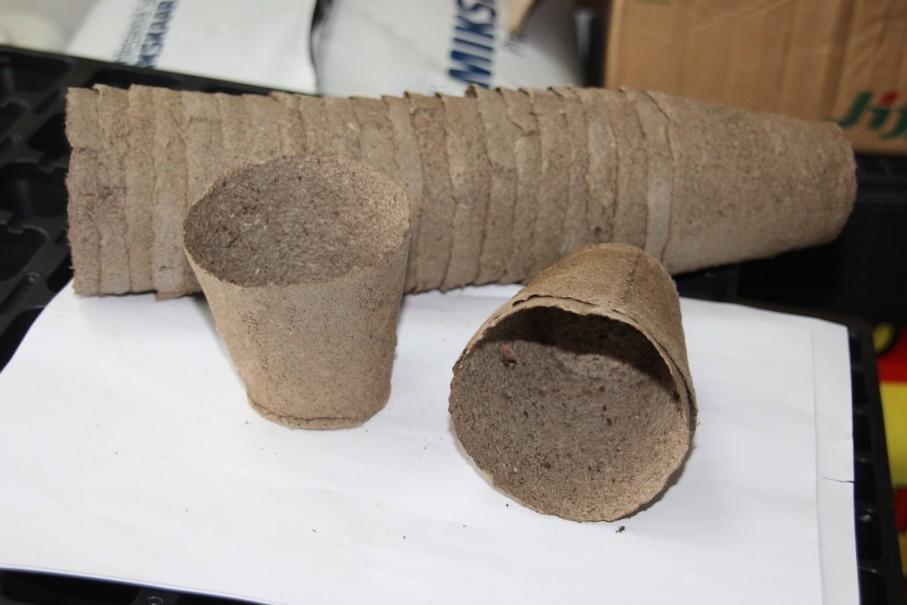
Quality peat-humus pots contain a lot of peat, which is why they are dark in color. Lighter ones are cheaper.

Regardless of the culture, you need to arrange the pots during the 2-3 phases of the real leaf. In the initial stages, the seedlings are small, so the pots can be placed close to each other. In the future, they grow, begin to shade neighboring plants.
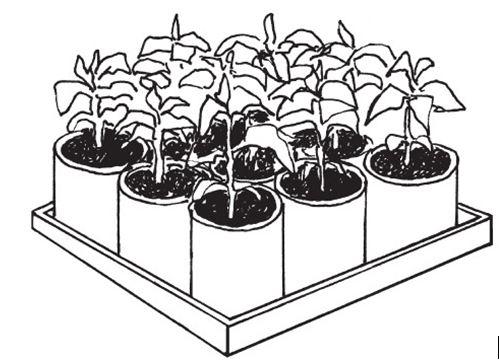
That's why they need to be moved apart (immediately putting them thinly is ineffective due to the large area that needs to be heated). This process is called placement.
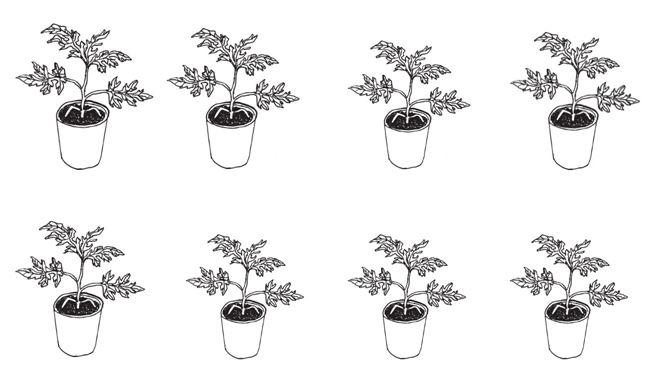
The first arrangement, which is carried out for 2-3 real leaves

The first arrangement is carried out for 2-3 real leaves. For her, the pots are placed one after the other with the calculation that the distance between each is equal to the diameter of one. According to this scheme, 22-24 pots are obtained per 1 m2. Gradually, the plants grow, and during phases 4-5 of a true leaf, a second arrangement is carried out, in which one row is left unchanged, and each second is moved one by one, so that they form something like the Olympic rings with the adjacent (unchanged) row.
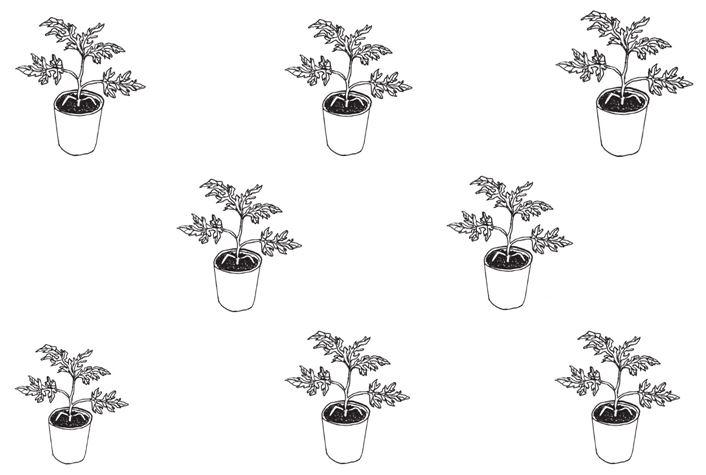
The second arrangement of pots in the form of the symbol of the Olympics

In this case, we get 12-14 pots per m2. Although this method seems complicated, it is simple, after mastering it, you can save a lot of effort and time, and adhere to the ideal recommended thickness.

Often, the role of pots is successfully performed by containers made of dairy products. The main thing is that the volume is at least 0.5 l, and from the bottom - make 2-3 holes for the outflow of excess water.

Yurii Sleptsov, associate professor ([email protected])
Обсуждение, комментарии Agro-forumе
Full or partial copying of materials without the written consent of the site administrator tractor-service.com is prohibited and will be considered a copyright violation.
See also    Publications
Cassettes for growing seedlings. Types of cassettes. Requirements for the quality of cassettes and seed material. Using cassettes for mechanized sowing and planting seedlings.
Stages of growing seedlings, consumables, operations with seedlings in a cycle of articles.
Seedling adsorbing pills (tablets) are a popular material for the production of seedlings. When moistened, they dramatically increase their volume and shape. As the plants grow, they are easy to dive into pots without damaging the root system. But there are also nuances, which we will talk about in the article.
Agrofiber, its types, purposes, methods of application. How to choose agricultural fiber (cpanbond). Types of packaging of agricultural fiber for sale.
The future harvest largely depends on the seed material. Let's consider what to pay attention to when buying seeds.
Glass as a covering material for greenhouses. Features of using glass as a covering material, advantages and disadvantages. What modern greenhouse glass is offered today.
Greenhouse polyethylene film as a cheap and effective covering material for greenhouses. Disadvantages of polyethylene film, measures taken by manufacturers of greenhouse film to improve its properties. What does the color marking of the film mean. Multi-layer film, reinforced film, films with anti-fog effect, thermal insulation...
Practical aspects of using the Slantrange system and Slantview programs for crop management. Classification of monitoring equipment by generation, comparison of monitoring solutions. The location of the Slantrange complex in the given classification. Monitoring of stress factors for plants from...
UAVs are today an integral part of crop management technology. There are different solutions for different areas. For industrial sites, the Slantrange complex, which has a wide range of additional capabilities, is a good solution.
Possibilities of using an RTK complex based on a drone by farmers for accounting and control, as well as organizing work directly in the field. An example of an RTK complex based on the DJI Phantom 4 RTK drone.
ru
/ru/
0