Ground equipment for monitoring crops by color for the organization of differentiated fertilizer application
High prices forfertilizers and the issue of their rational use are always relevant, including for prevention ecological problems of uncontrolled ingress of nitrates into the surrounding environment and in particular reservoirs, surface groundwater.
Specialized equipment that performs non-contact operational assessment of the state ofnitrogen nutrition for the organization of differentiated fertilizer application.
Differentiatedfertilizer application, - provides that fertilizers are applied selectively, where the need for certain fertilizers is particularly urgent. Moreover, two main methods are used: application in real time and application from a previously prepared map of the field.
The principle of operation of such equipment will be explained on the example of wheat, which needs to be fertilized several times during its growing season.
One of the main stages of feeding is the stage of "coming into the tube". The picture shows a photograph in the optical range of a hospital for studying fertilizer application systems at this stage of vegetation.
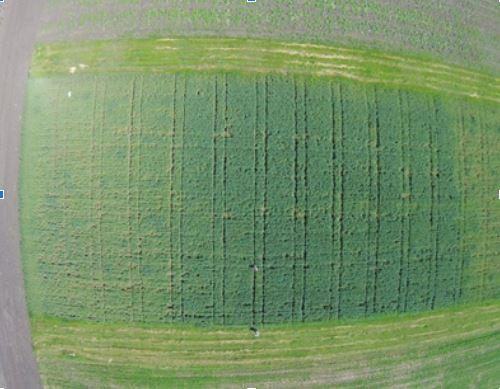
Analyzing the image, we see that the area near the road (on the left) has not been fertilized for years. After that, there are 5 more plots where fertilizers were applied with increasing concentration, while 150% of the recommended dose of nitrogen fertilizers was already applied to the last of the 5 plots. In the future, to check the results (organization of repetition of experiments), the dosage of fertilizers is again reduced to zero. Closer to the road, the color of the plants has a light green shade, which turns into emerald with an increase in the dose of fertilizers. That is, color is an informative parameter.
This phenomenon is well known to agronomists, and a qualified specialist can determine the required amount of fertilizers with sufficient precision. The question remains - where to get such qualified specialists en masse?
A possible option is consulting services, when specialists are invited in case of need or receive consultations remotely. The development of the Internet and digital photography have greatly simplified manufacturers' access to databases for sheet diagnostics. Now it is enough to take a picture and contact the appropriate site, where consultations are provided due to the involvement of experts and machine learning technologies.
There are both paid and free products on the domestic market, although with rather limited functionality. As an example, the service Helping Plants A (http://az.4androidapk.com/developer/qvet) and Yara CheckIT (https://www.yara.ua/) are free and work in offline mode, while using one of the applications of the Dinut software series (for different cultures) is paid.
Such services are primarily intended for diagnosing plant diseases and identifying pests, although issues of mineral nutrition are also diagnosed to a certain extent - a general indication of a lack or excess of a nutrient element. The indicator rather than the measuring mode is primarily explained by the complexity of the organization of lighting correction.
However, for industrial equipment, such measurements are quite possible, both with purely natural lighting and with the use of special lamps. Differentiated application of fertilizers can be carried out both by controlling the supply of the reagent and by controlling the speed of movement of the equipment on the field. Both technologies have their advantages and disadvantages. Thus, when controlling bandwidth, it is possible to increase selectivity, when the amount of application is selected individually for each of the field strips. However, this limits the nomenclature of fertilizers to a certain extent, since when the pressure changes with colloidal solutions, characteristic of fertilizers, incorrect application of the active substance is possible. Speed control is technically easier to organize and even automate in existing aggregate motion control systems.
There are several manufacturers of such serial equipment on the market of Ukraine:
GreenSeeker
GreenSeeker by Trimble Agriculture (USA) has both a purely measuring system and a specialized complex designed for differentiated application of fertilizers based on the size NVDI index. To increase the selectivity of the received data, it is possible to install several measuring units in parallel. The on-board system can use its own light source for each measurement channel, so it can work both during daylight hours and at night.
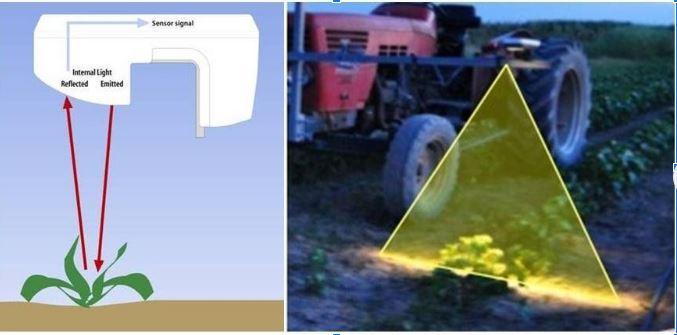
GreenSeeker spectral sensor system, device diagram and photo of the kit's use at dusk.
CropSpec
One of the companies working in the field of developing optical sensor systems, Topcon Positioning Systems (Japan), in cooperation with Yara International, created a system for optical diagnostics of plant nitrogen supply based on the CropSpec sensor. The Topcon system uses two sensors, one on each side of the complex to measure the spectral characteristics of the crop - the NDVI index.
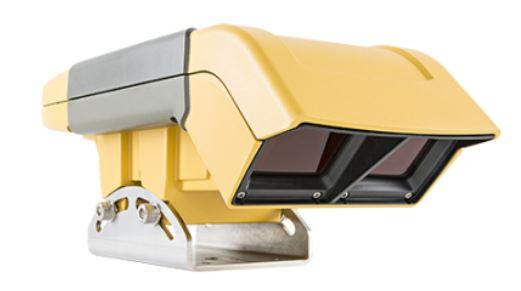
The CropSpec sensor is designed to measure the state of nitrogen nutrition of plants.
Just like the previous sample, the system has its own radiation source to ensure 24-hour operation.
Crop Circle ACS-430
Another technical means for implementing variable fertilizer rationing technology is an optical sensor. Holland Scientific Crop Circle ACS-430 (USA). It also belongs to the group of active sensors, and has its own light source (LED) and a three-channel silicon detector with a spectral range of 320-1100 nm.
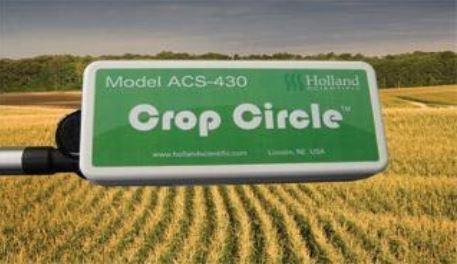
Crop Circle Sensor ACS-470
The optical system includes three optical measurement channels, which allows the user to work with several wavelengths, nm: 450, 550, 650, 670, 730, 800. Several stress indices can be used (NDVI, SRI, etc.), which allows the use of the complex for quantitative assessment of the impact of nutrients, ensuring moisture detection of plants, detection of plant diseases or other signs of stress.
CropSensor
The OptRx optical sensor is the next generation of these Holland Scientific devices, built on the experience and development of Crop Circle operation. It is sold under the AG Leader brand under the name CropSensor. The OptRx-based implementation of variable fertilizer rationing technology uses the same calibration dependence parameters as for the previous generation sensors.
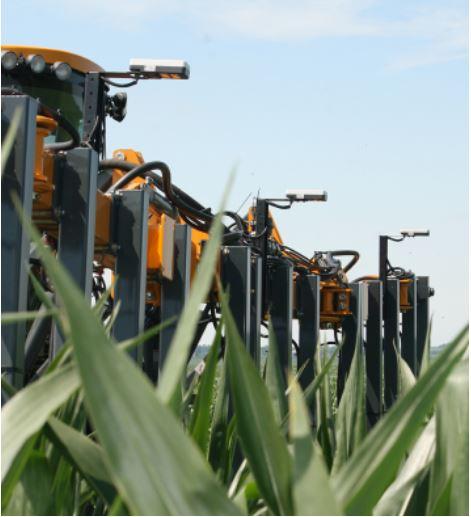
The OptRx sensor, mounted on the base of the fertilizer application equipment
N-sensor
One of the first industrial means of optical diagnostics is the N-sensor manufactured by Yara International (Norway). This is a passive optical system consisting of four photomatrices that determine the intensity of reflected sunlight, and one zenith photocell to determine the intensity of sunlight in the wavelength range of 660-800 nm.
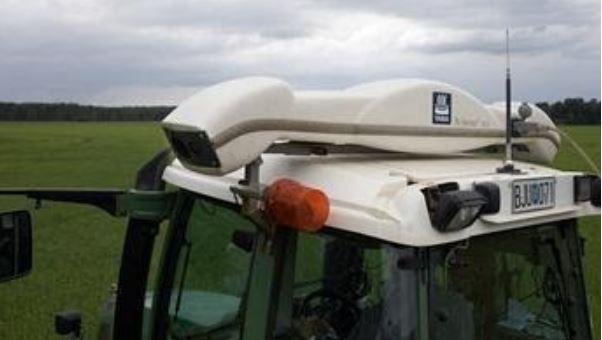
Yara N-Sensor
The photocells are connected to a computer unit and issue a signal to control the operation of the fertilizer spreader. At the beginning of the work, a sowing area typical of the total area is chosen and sensors are calibrated, according to which the average intensity of reflected light and the corresponding dose of nitrogen fertilizers (in physical mass) are set. The next operation (operating mode) is the measurement of the intensity of the reflected light and the synthesis of the received information, which is transmitted to the means of controlling the spreader's operation. The disadvantage of this complex is that the source of light is the sun, so the working time is limited to 10-12 hours during the day.
Let's summarize..
These technologies are able to save the economy money due to the rational use of fertilizers and ensure the appropriate quality of grain. However, such equipment requires methodical support, namely calibration dependencies between the state of nitrogen supply and spectral indicators. This will be served by the creation of own stationary experiments on the use of fertilizer systems, on which to calibrate the equipment.
The existing nomenclature of serial equipment shows that these technologies are already the realities of the present, and not a fantastic future. They are able to save the economy money due to the rational use of fertilizers and ensure the appropriate quality of grain. However, such equipment also needs certain methodical support.
Unfortunately, centralized state methodological support is insufficient, and ready-made calibration dependencies between the state of nitrogen supply and spectral indicators are insufficient. However, farms are capable of creating such dependencies themselves. As an example, - the creation of own stationary experiments on the use of fertilizer systems, on which to carry out equipment calibration. This approach is also used abroad, when the company selects for itself the optimal fertilizers in terms of availability and cost. Gradually, the farm accumulates its own data bank both regarding calibration dependencies and digital field maps, which are extremely useful for agrarian practices.
Therefore, despite the increasingly advanced auxiliary equipment, the agronomist will not remain without work.
Beekeeper Natalya Anatoliivna ([email protected])